










Poultry Shed Electrical Load Calculation: Worked Example for Control Sheds (Pakistan)

Short answer: a poultry shed electrical load calculation means listing every fan, pump, feeder motor, light and controller, converting each nameplate rating into running kVA and amps per phase, adding a safety margin, and then checking the extra surge when motors start. In our worked example below, a control shed with eight 1.1 kW exhaust fans needs about 20 kVA while running, roughly 31 A on the busiest phase, a 40 A to 63 A four-pole main breaker, and a generator of about 30 kVA only if the fans are started one by one. Start them all together and the same shed would need a generator three times bigger.
Bohat se farms panel, cable aur generator “andaze se” buy kar lete hain, and then wonder why the breaker trips at 2 pm in June or why the generator stalls when power returns after load-shedding. This guide gives you a simple, repeatable method that any farm owner, electrician or panel builder in Pakistan can follow on paper, using the nameplates already on your equipment.
Why load calculation matters more in a control shed
In an open shed, a short power cut is uncomfortable. In a closed (control/environment-controlled) shed, ventilation is the life-support system. When the fans stop, heat and ammonia build up quickly, which is why the backup system has to be sized correctly, not guessed. A proper poultry shed electrical load calculation tells you:
- the size of the WAPDA / DISCO connection and sanctioned load you should apply for (most control sheds need a three-phase connection);
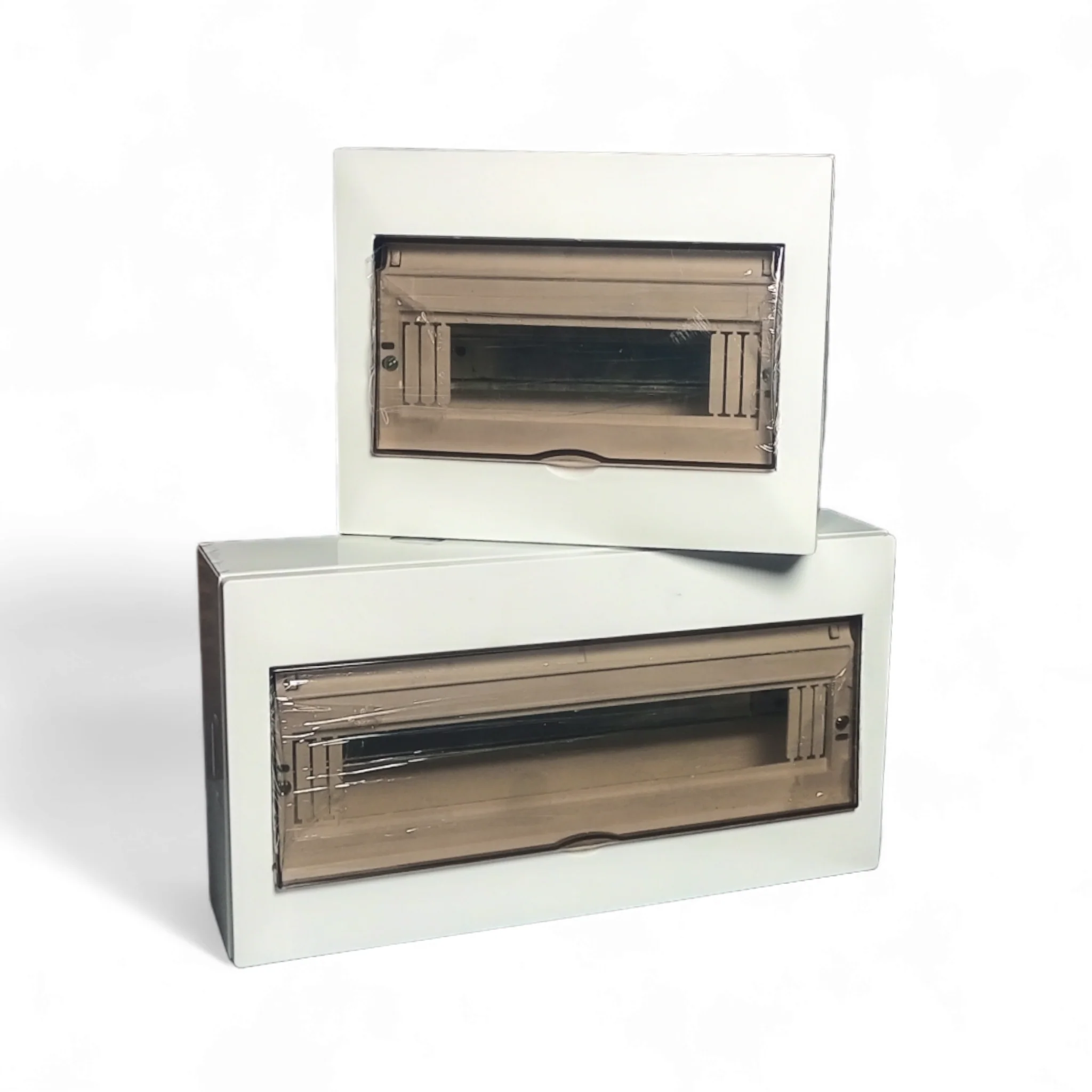
- the rating of the main breaker (MCB or MCCB), the main cable and the busbar in the poultry farm electrical panel;
- the contactor and overload size for each exhaust fan or fan group;
- the generator size and the ATS or changeover switch rating;
- whether a three-phase solar hybrid inverter can carry daytime fans, and how much.
Step-by-step poultry shed electrical load calculation (6 steps)
Step 1: List every load from the nameplates
Walk the shed with a notebook. For each machine write down the quantity, rated power (kW or HP), voltage (230 V single-phase or 400 V three-phase) and, most importantly, the rated current (A) printed on the motor plate. Typical items in a Pakistani control shed are tunnel exhaust fans, cooling-pad pumps, feed-line and pan-feeder motors, the drinker/water pump, LED lighting, the climate controller, sensors and alarm, and sometimes brooding heaters or a fogging pump.
Tip: if the plate shows HP, multiply by 0.746 to get kW. The plate value is the motor’s output; the electrical input is higher because of motor losses.
Step 2: Convert output kW into running kVA
Two corrections turn a motor rating into what your cable and generator actually see:
- Input kW = output kW ÷ efficiency (small fan motors are often around 0.7 to 0.85; use the plate value if printed).
- kVA = input kW ÷ power factor (cos φ on the plate, commonly about 0.75 to 0.85 for small motors).
Lighting and electronics are close to their rated watts. If you have the plate current, you can skip the maths: three-phase kVA = 1.732 × 400 V × amps ÷ 1000, and single-phase kVA = 230 V × amps ÷ 1000.
Step 3: Work out amps per phase and balance the phases
Three-phase motors draw the same current on all three phases. Single-phase loads (lights, a single-phase pump, the controller) land on one phase each, so spread them across L1, L2 and L3. Your breaker and cable are sized for the busiest phase, not the average.
Step 4: Decide what really runs together
On a summer afternoon, every tunnel fan, both pad pumps and the lights can run at once, and feeders may switch on at the same time. For poultry, assume full simultaneous load for the hottest period. Do not apply generous “diversity” discounts you might use for a house.
Step 5: Add a margin
Multiply the running current by 1.25, then round up to the next standard breaker size. The margin covers low-voltage days (when motor current rises), dusty fan blades, ageing bearings and the extra fan you will add next season.
Step 6: Check the starting surge (the step most people skip)
A fan motor started direct-on-line (DOL) draws several times its running current for a second or two. The Ontario farm generator guide suggests planning for at least four times running watts for motor start-up, ranging from two to twelve times in extreme cases. The motor maker’s locked-rotor data is always better than a rule of thumb. This surge decides the generator size far more than the running load does.
Worked example: control shed with 8 exhaust fans
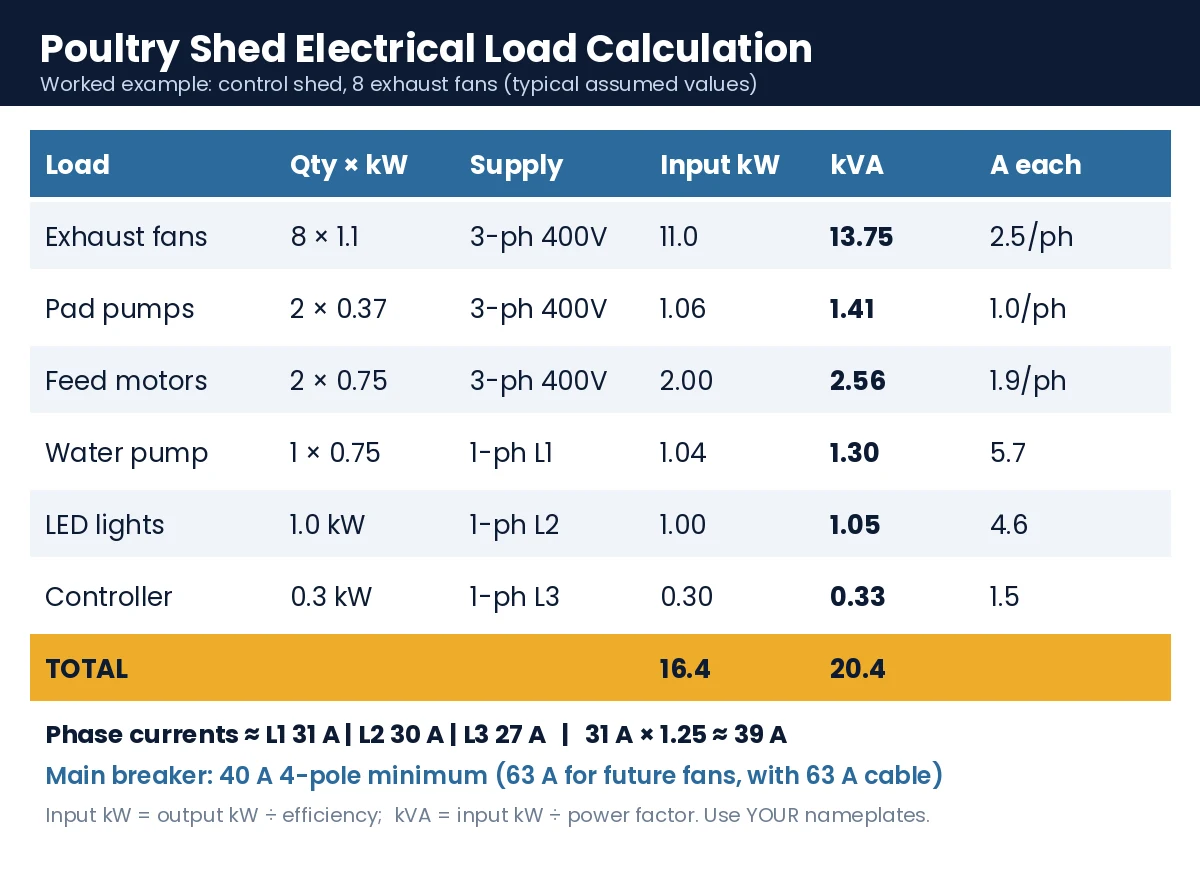
The figures below are an illustrative example with typical assumed values, not data from a specific farm. Replace them with your own nameplate values.
| Load | Qty × rating | Supply | Assumed efficiency / PF | Input kW | Running kVA | Amps each |
|---|---|---|---|---|---|---|
| Tunnel exhaust fans | 8 × 1.1 kW | 3-phase 400 V | 0.80 / 0.80 | 11.0 | 13.75 | ≈2.5 A per phase |
| Cooling-pad pumps | 2 × 0.37 kW | 3-phase 400 V | 0.70 / 0.75 | 1.06 | 1.41 | ≈1.0 A per phase |
| Feed-line motors | 2 × 0.75 kW | 3-phase 400 V | 0.75 / 0.78 | 2.00 | 2.56 | ≈1.9 A per phase |
| Drinker / water pump | 1 × 0.75 kW | 1-phase 230 V (L1) | 0.72 / 0.80 | 1.04 | 1.30 | ≈5.7 A |
| LED shed lighting | 1.0 kW total | 1-phase 230 V (L2) | – / 0.95 | 1.00 | 1.05 | ≈4.6 A |
| Controller, sensors, alarm | 0.3 kW | 1-phase 230 V (L3) | – / 0.90 | 0.30 | 0.33 | ≈1.5 A |
| Total | 16.4 kW | 20.4 kVA |
Phase currents: the three-phase motors add up to about 8 × 2.5 + 2 × 1.0 + 2 × 1.9 ≈ 25.6 A on every phase. Adding the single-phase loads gives roughly L1 ≈ 31 A, L2 ≈ 30 A, L3 ≈ 27 A. That is a reasonably balanced panel; if one phase were 10 A higher than the others, you would move single-phase circuits around.
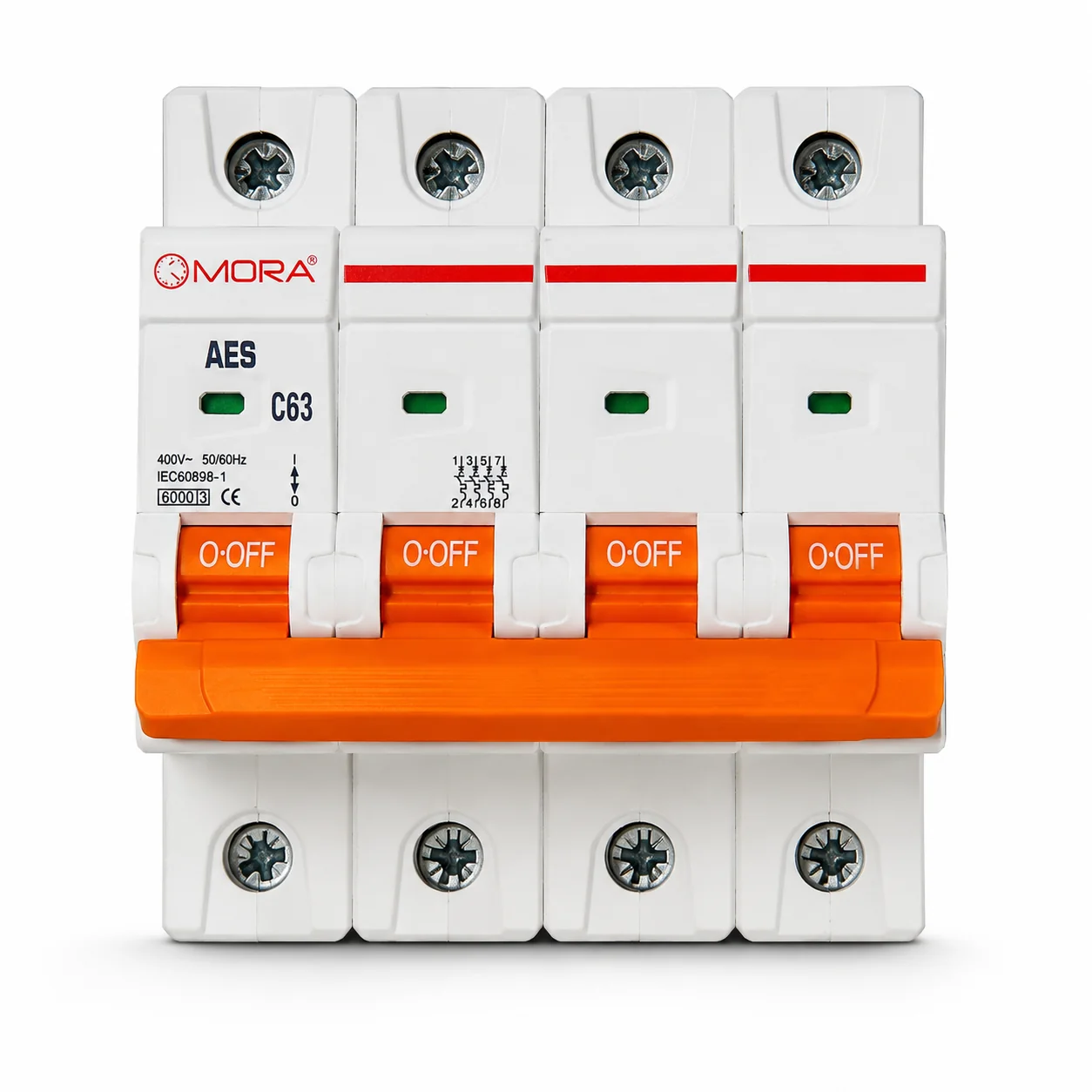
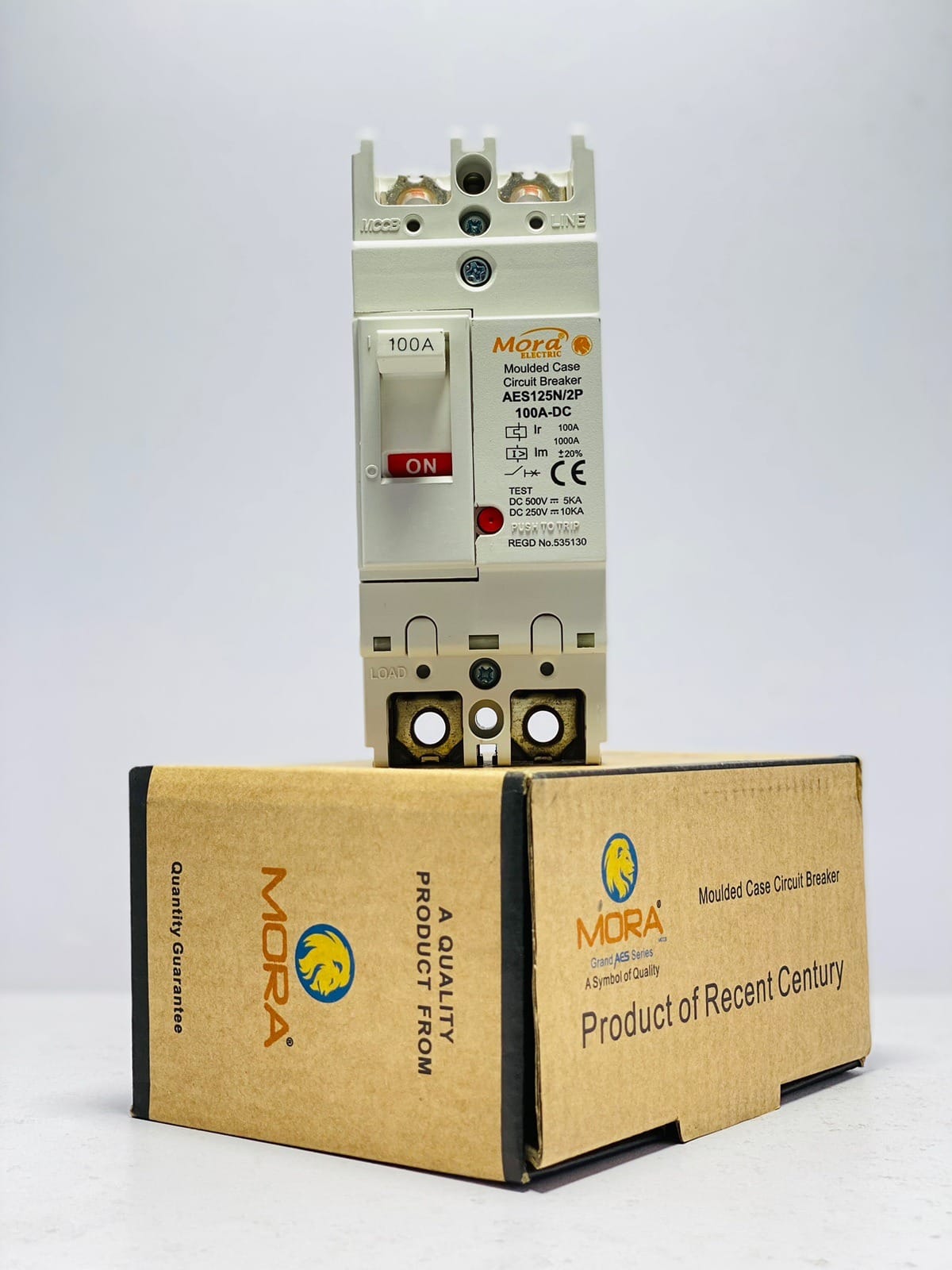
Main breaker: 31 A × 1.25 ≈ 39 A, so a 40 A four-pole breaker is the minimum. Many farms choose 63 A to leave room for extra fans, but then the main cable must also be rated for 63 A (the cable must always be rated above the breaker). For bigger sheds or two sheds on one incomer, step up to an MCCB; our MCB vs MCCB vs RCCB vs RCBO guide explains where each fits.
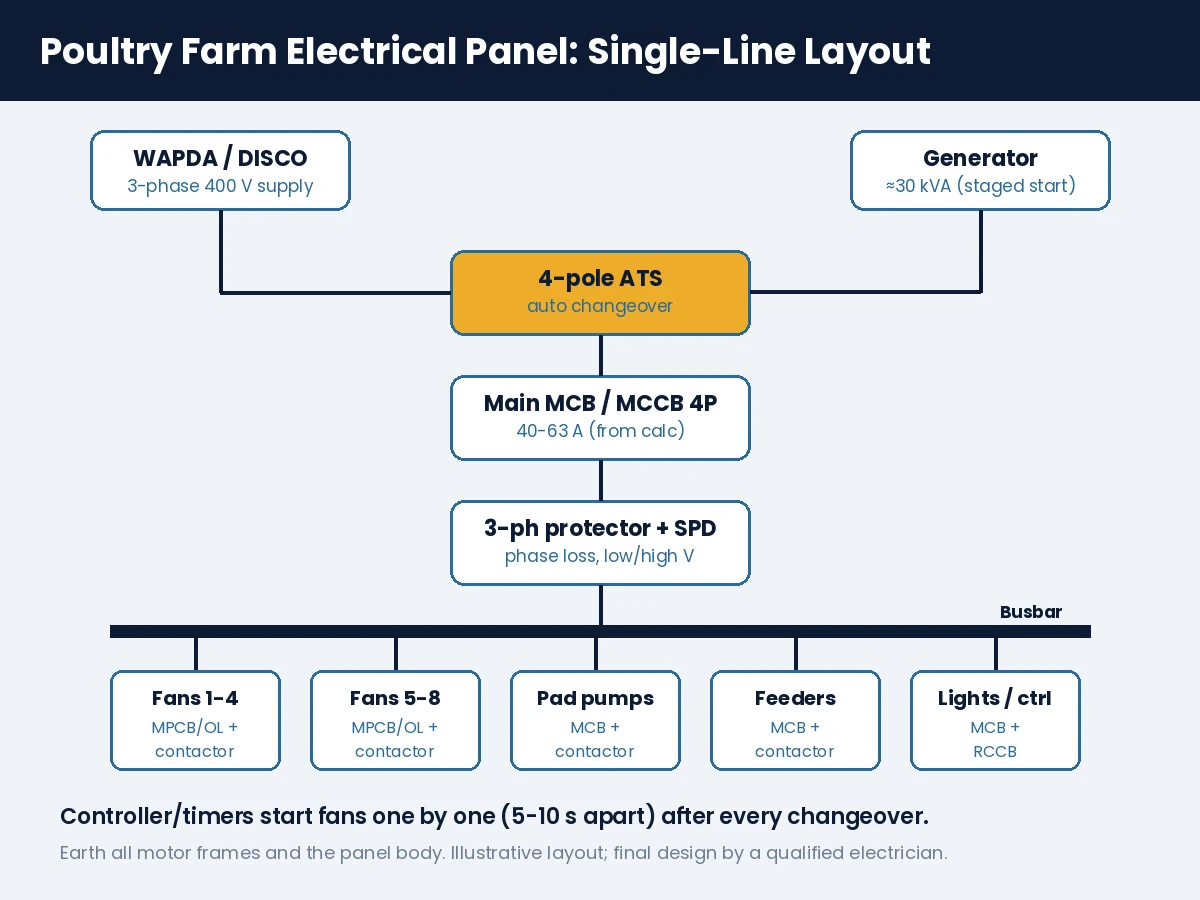
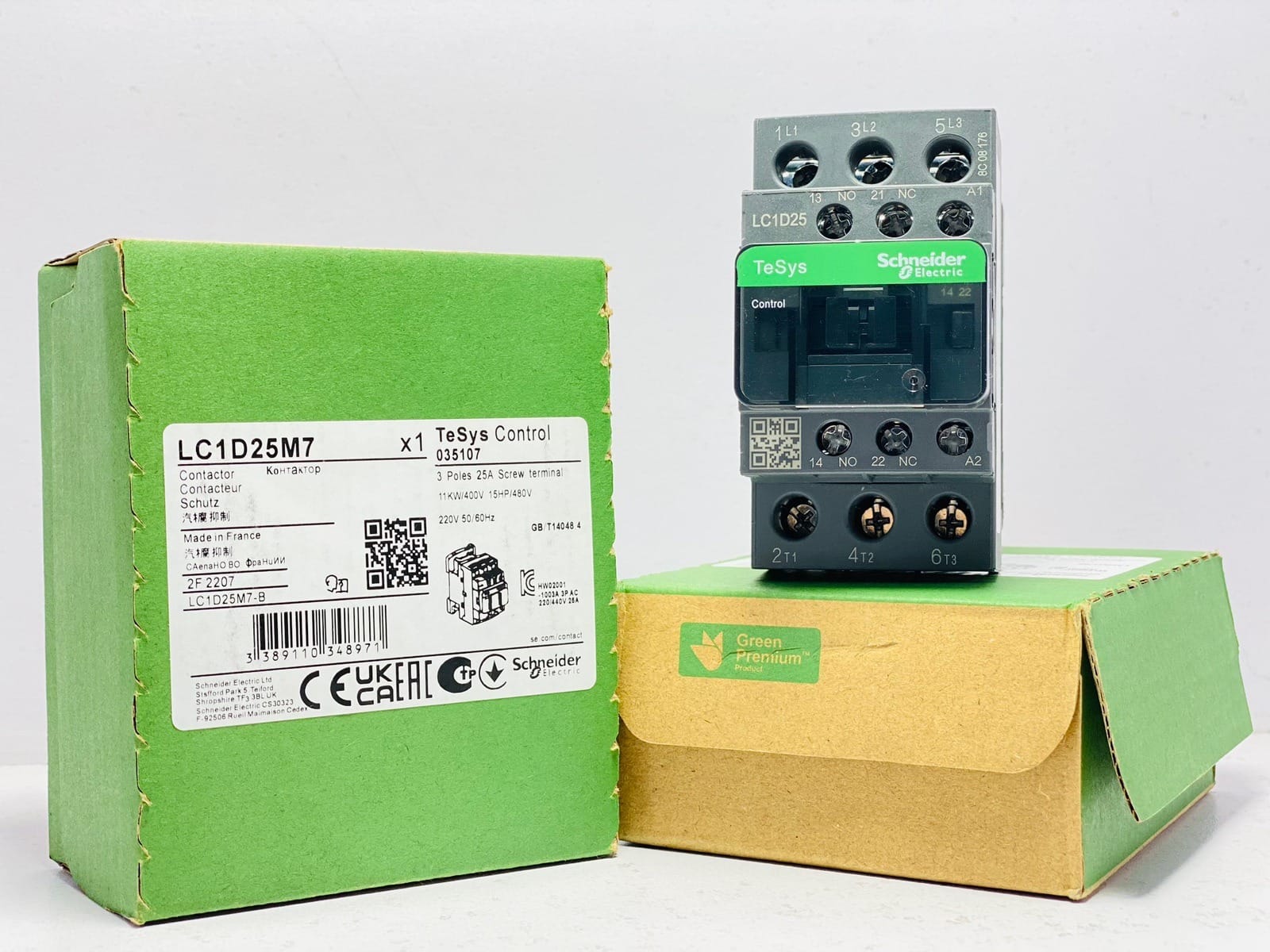
Per-fan protection: each 2.5 A fan needs a thermal overload (or motor protection breaker) set to its plate current, a short-circuit device, and a contactor rated for motor duty (AC-3) above the motor current. A small 9 A AC-3 contactor such as the Schneider LC1D09 comfortably switches one or two fans of this size; larger fan groups move up to 18 A or 25 A frames. For the full fan-panel wiring diagram and parts list, see our exhaust fan control panel guide for poultry sheds.
Generator sizing for a poultry farm: staged start vs all-at-once
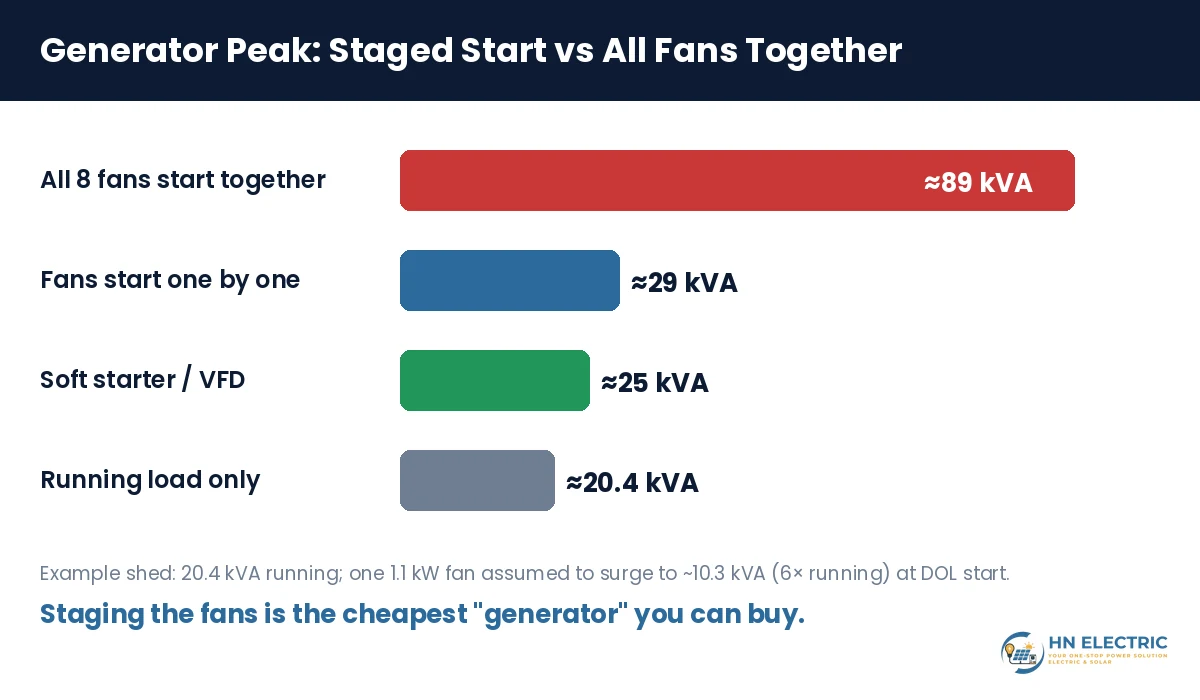
Using the example running load of 20.4 kVA, and an assumed DOL starting surge of 6 × running kVA for one 1.1 kW fan (about 10.3 kVA, inside the 4 to 8 times range typical for small motors), compare the two ways power can come back after load-shedding:
| Restart method | How the peak is worked out | Approx. peak demand | Generator guidance |
|---|---|---|---|
| All 8 fans start together (no staging) | Other loads 6.7 kVA + 8 × 10.3 kVA starting | ≈ 89 kVA | Huge oversizing, or voltage dip and stalled fans |
| Fans start one by one (5 to 10 s apart) | Everything else running ≈ 18.7 kVA + one fan starting 10.3 kVA | ≈ 29 kVA | About 30 kVA, checked with the generator supplier for motor starting |
| Fans on soft starters or VFDs | Starting current held close to running current | Close to running load + margin (≈ 25 kVA) | Smallest generator; adds VFD cost and needs harmonics check |
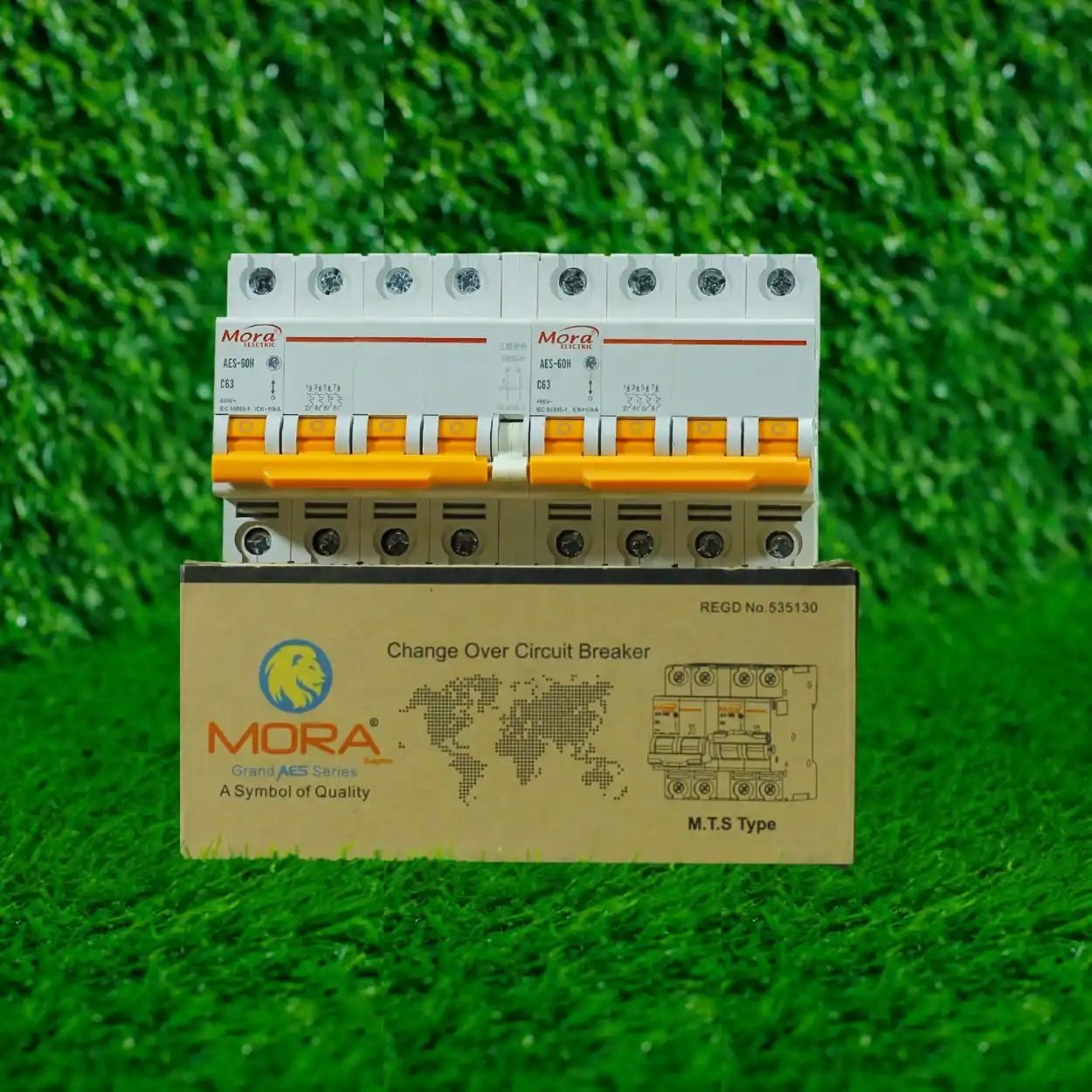
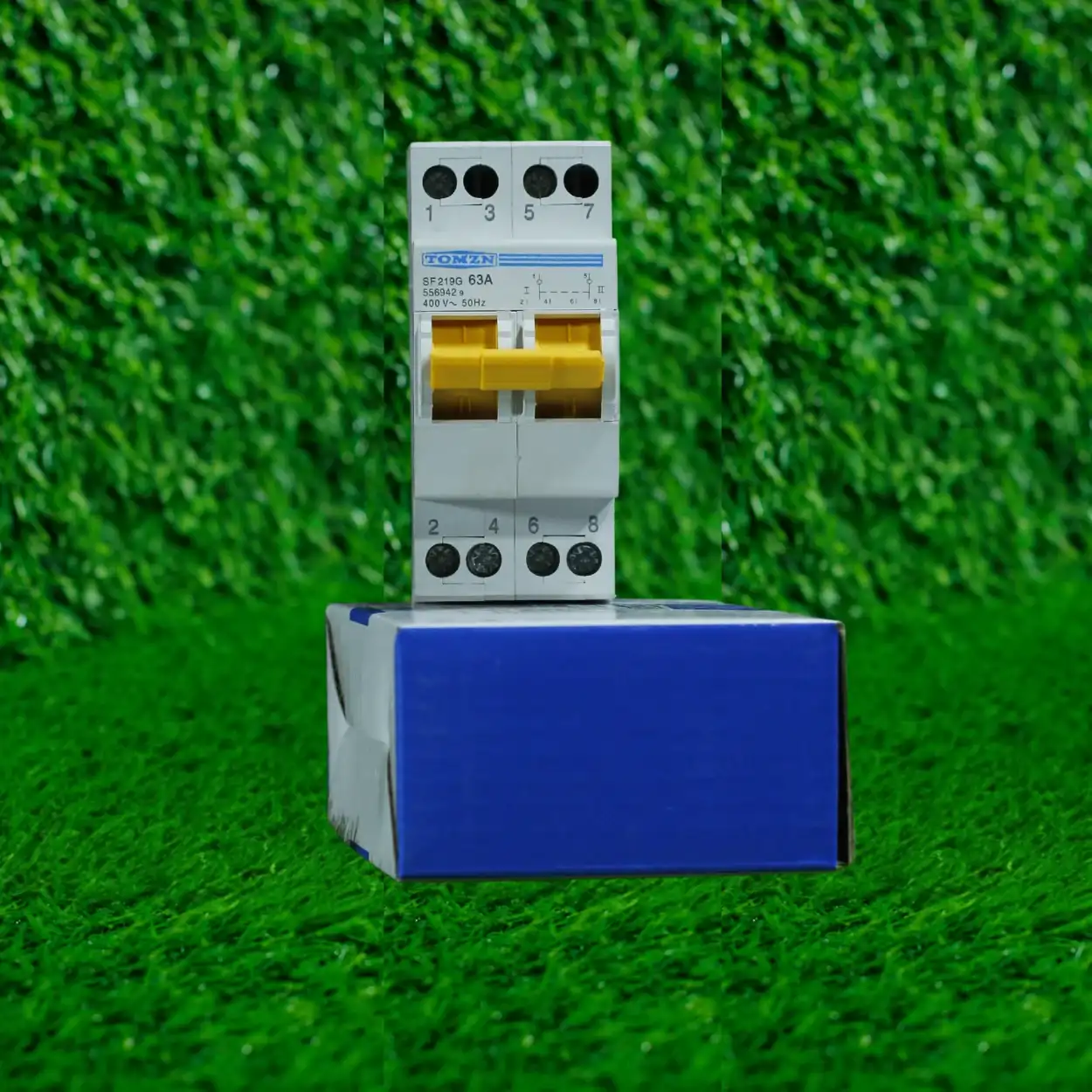
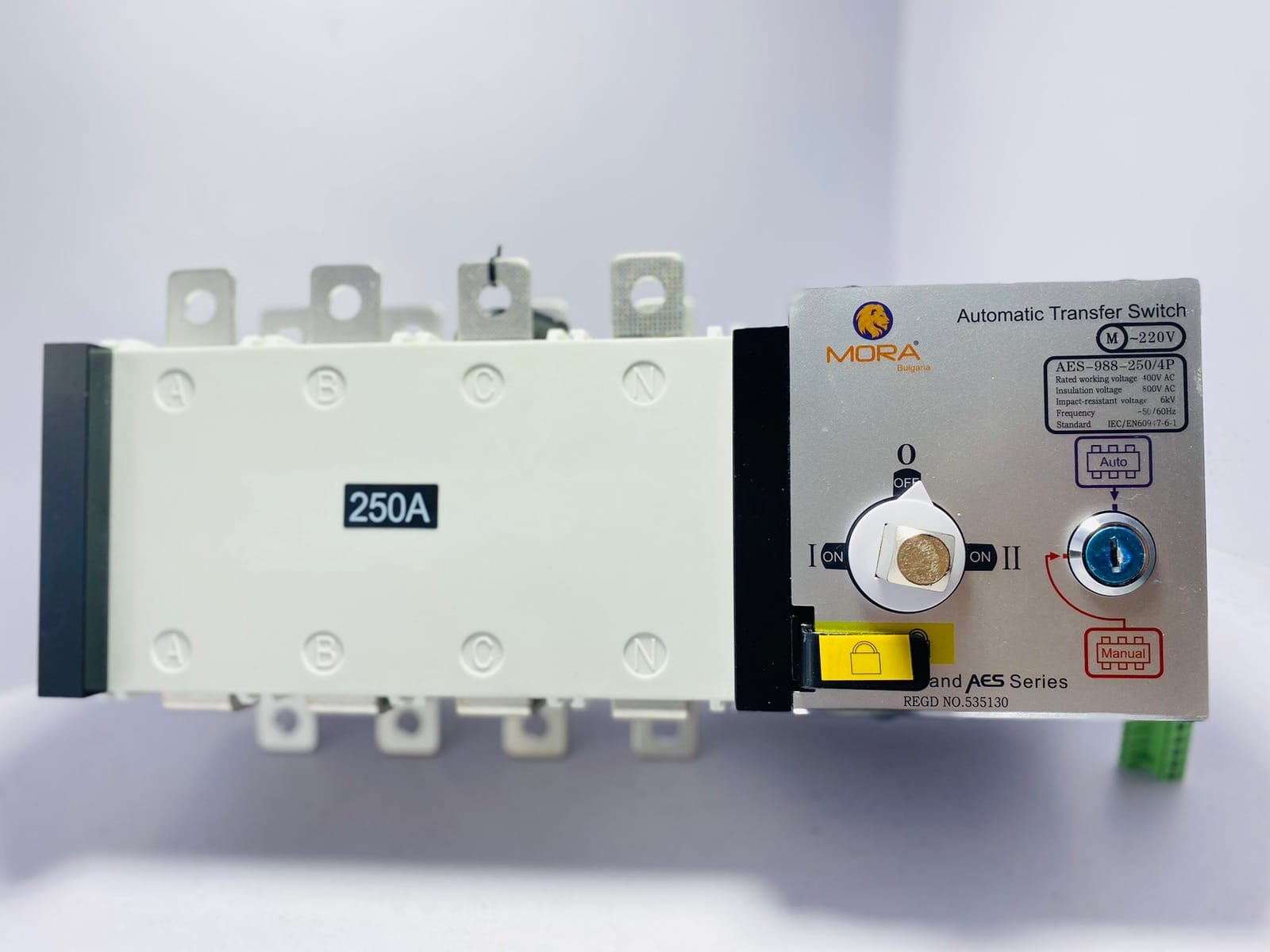
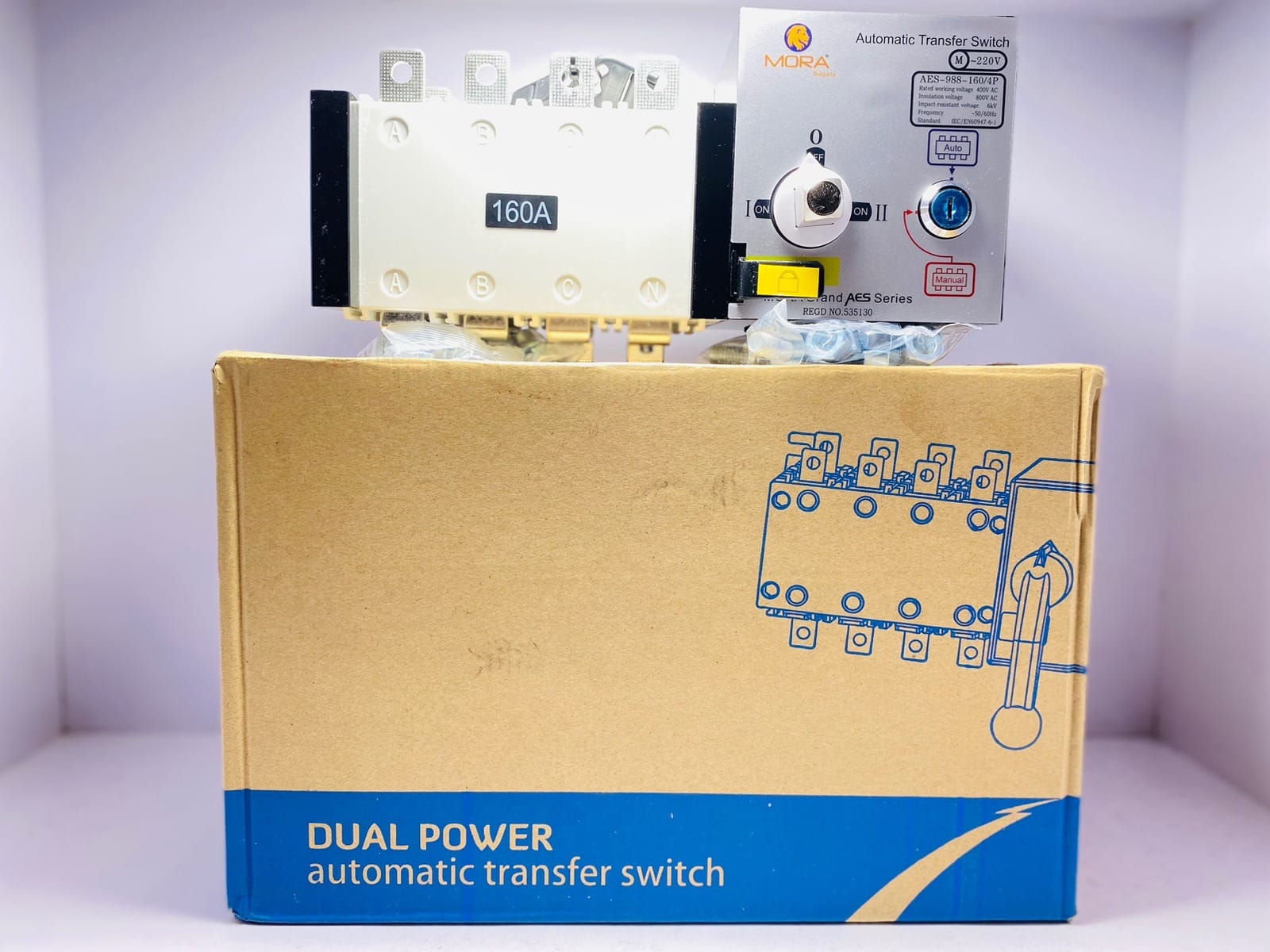
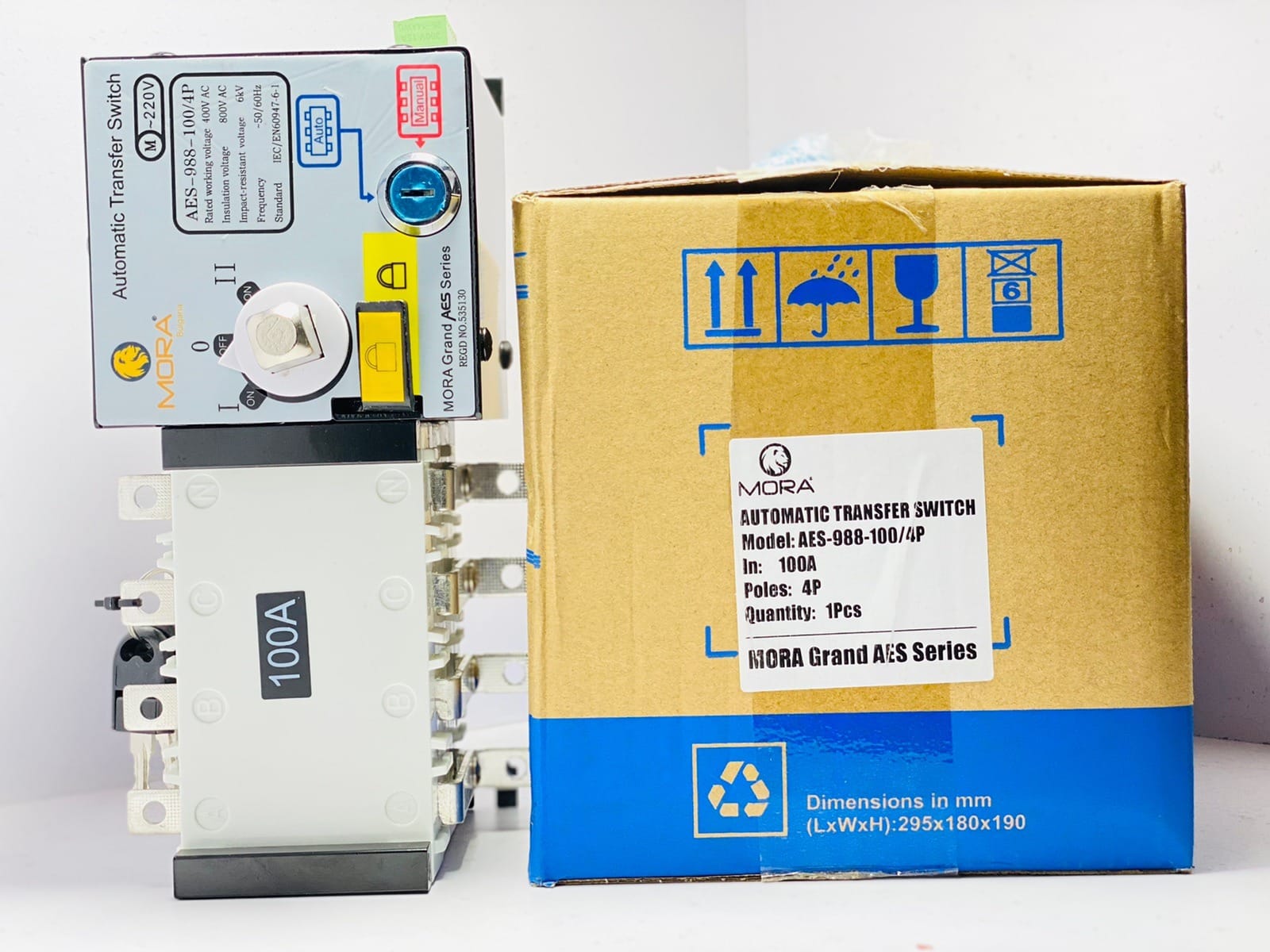
The lesson is simple: staging the fans is the cheapest “generator” you can buy. The climate controller or a set of simple on-delay timers can bring fans in one after another. Pair this with an automatic transfer switch so the shed changes over without anyone running to the panel at 3 am; a four-pole unit such as the MORA 100A 4-pole motorised ATS suits a 40 to 63 A shed incomer with room to spare.
Pakistan-specific checks for poultry farm electrical wiring
- Low voltage on rural feeders: when voltage drops in summer evenings, motor current rises and overloads trip. That is one more reason for the 25% margin and correct overload settings.
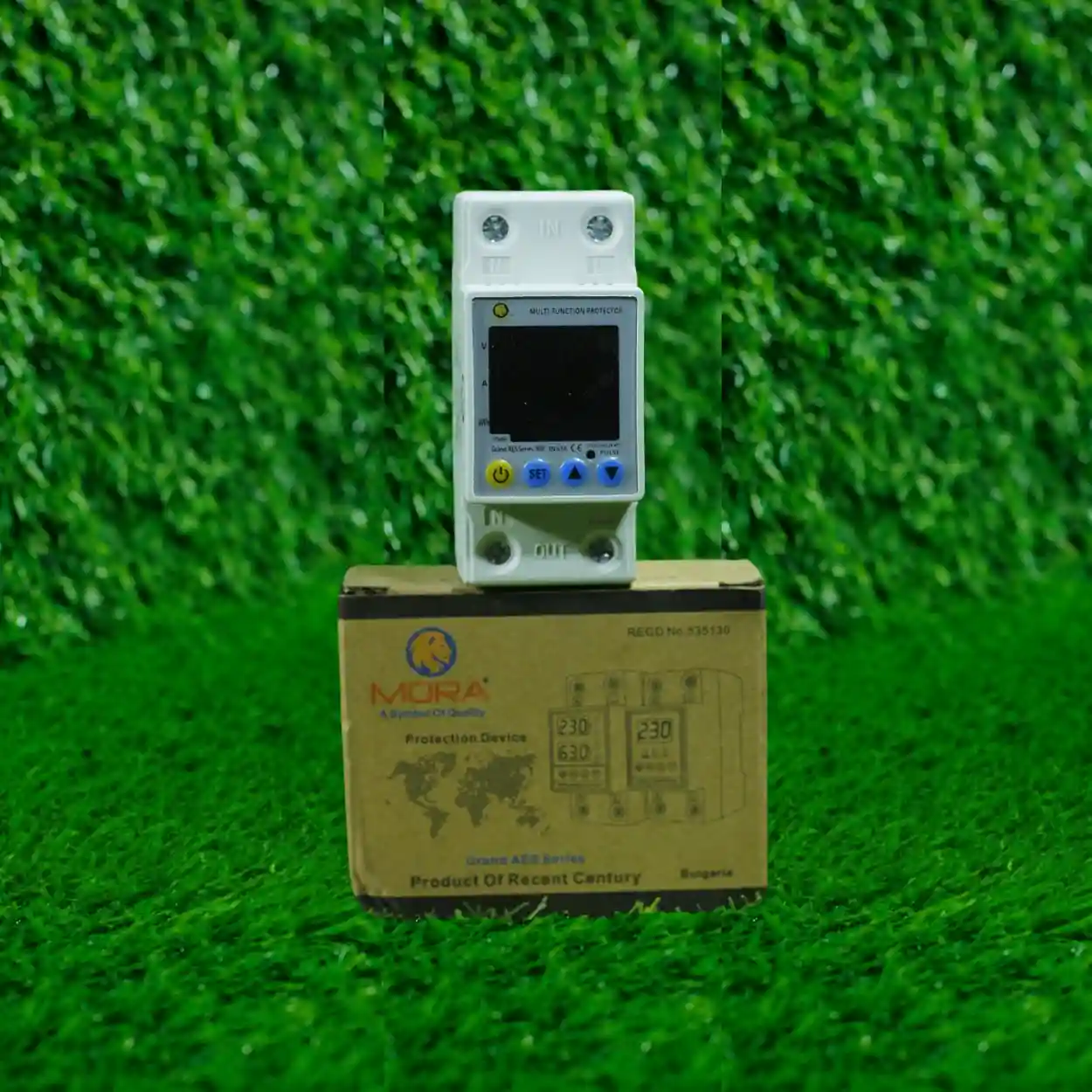
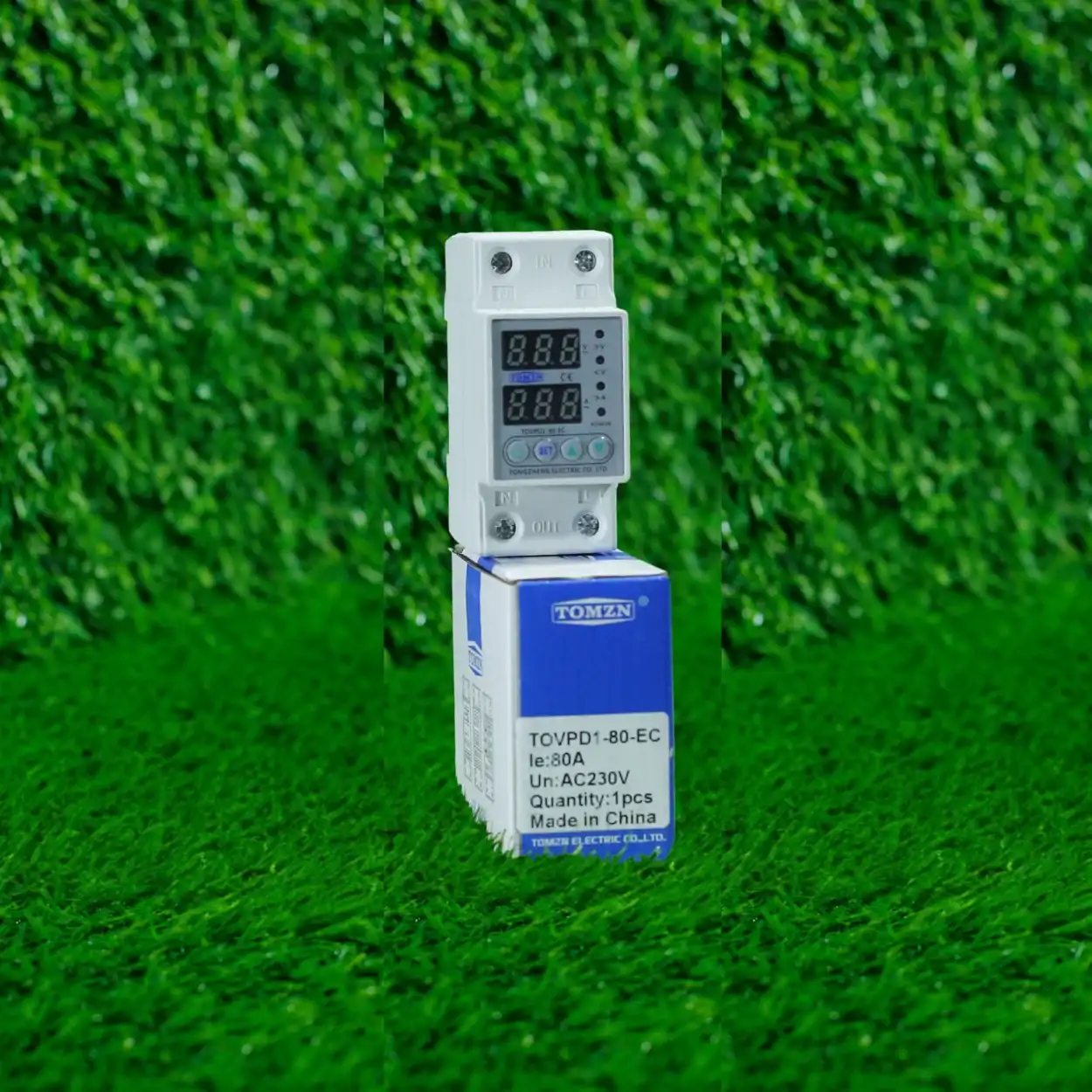
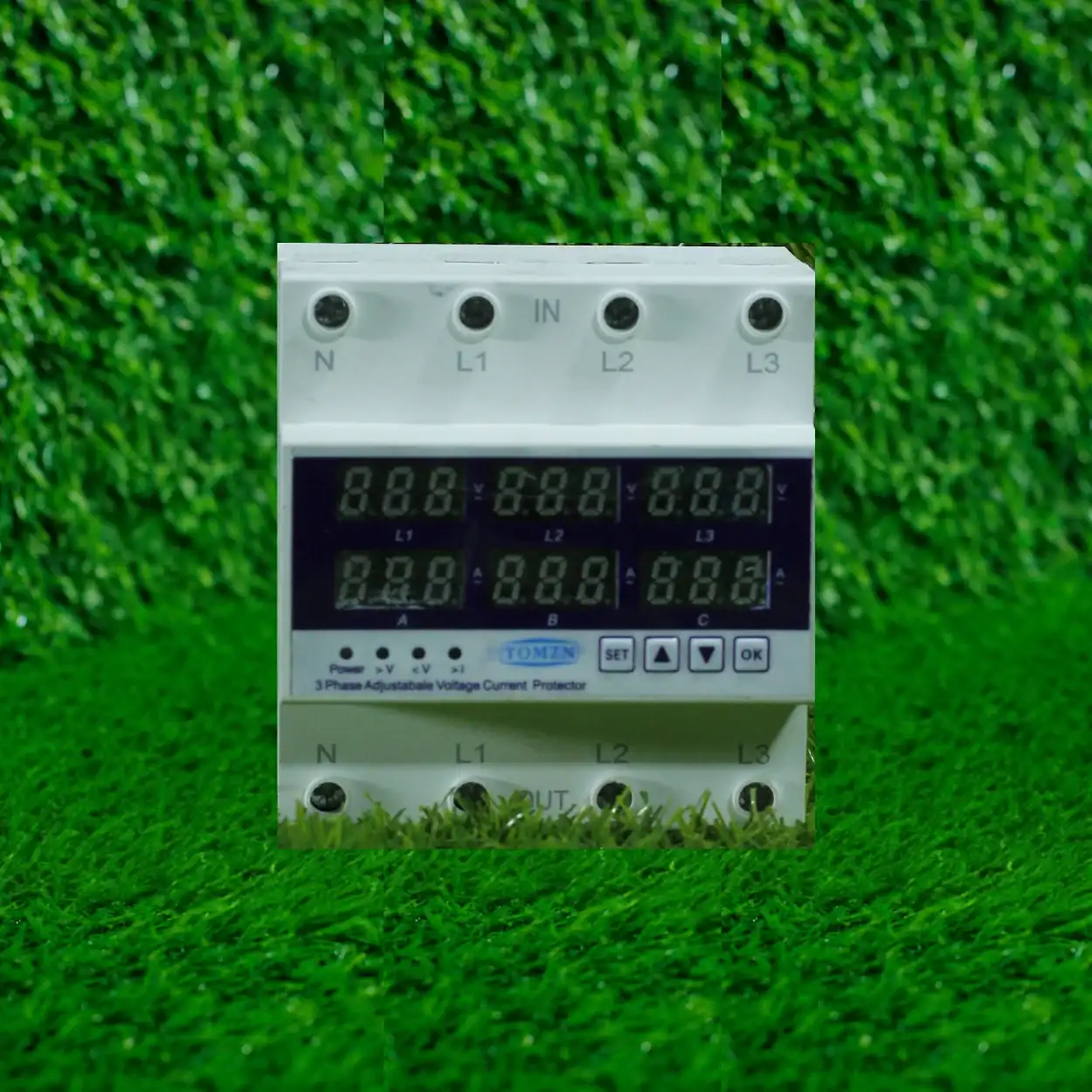
- Phase failure (single phasing): if one phase disappears, three-phase fan motors keep trying to run on two phases and overheat. A 3-phase voltage and current protector or phase-failure relay disconnects the panel before motors burn. Read more on three-phase voltage and overload protection.
- Sanctioned load: apply to your DISCO (LESCO, FESCO, MEPCO, GEPCO, IESCO etc.) for a connection that covers the calculated load, not the load you have today minus a guess.
- Lightning and surges: sheds in open fields with long overhead lines benefit from an AC surge protection device at the main panel, with a good earth pit.
- Solar hybrid: a three-phase hybrid inverter can carry daytime fans and cut diesel use, but motor starting surge still applies. Stage the fans and size the inverter’s surge rating against the same peak worked out above.
Safety notes
- Panel work on 400 V must be done by a qualified electrician with the supply isolated and locked off.
- Keep the poultry farm electrical panel dry, dust-sealed and away from cooling-pad spray; use cable glands, not open holes.
- Earth every motor frame and the panel body; use an RCCB on socket and lighting circuits where people work.
- Never upsize a breaker to stop nuisance tripping. Find the cause: a jammed fan, a lost phase or undersized cable.
- Test the ATS and generator under real load every week, not just with the generator idling.
Poultry shed load calculation checklist
- ☐ All nameplates recorded: kW/HP, voltage, rated amps, quantity
- ☐ Input kW and kVA worked out for each load
- ☐ Single-phase loads spread across L1, L2, L3; busiest phase identified
- ☐ Full simultaneous summer load assumed
- ☐ 25% margin added; main breaker and cable chosen (cable above breaker)
- ☐ Contactor (AC-3) and overload sized per fan or fan group
- ☐ Starting surge checked; fans staged by controller or timers
- ☐ Generator, ATS/changeover and solar inverter sized for the staged peak
- ☐ Phase-failure/voltage protector, SPD and earthing included
- ☐ Load list saved inside the panel door for future electricians
For a full list of panels, protection and backup equipment for farms, see our poultry farm electrical and solar solutions page, or browse magnetic contactors for fan control.
FAQ: poultry shed electrical load
How do I calculate the electrical load of a poultry shed?
List every motor, light and controller with its nameplate kW and amps, convert motor output to input kVA using efficiency and power factor, add the loads per phase, assume everything runs together in summer, add 25%, and then check motor starting surge for the generator.
What size generator do I need for a control shed?
It depends on the running load and on how the fans start. In our 8-fan example the running load is about 20 kVA; with fans started one at a time, a generator of about 30 kVA is a reasonable starting point, while starting all fans together would push the peak near 89 kVA. Confirm with the generator supplier’s motor-starting data.
Does a control shed need a three-phase connection?
Most do, because tunnel fans and pad pumps are usually three-phase motors and the total load is too high to run neatly on single phase. Three-phase also lets you balance lighting and controls across phases.
Which contactor should I use for an exhaust fan?
Pick a contactor whose AC-3 (motor) rating is above the fan’s rated current, with a coil voltage that matches your control circuit, and pair it with an overload relay or motor protection breaker set to the nameplate current.
Can I run poultry shed fans on solar?
Yes, during daylight with a correctly sized three-phase hybrid inverter and panels, and with fans staged so the inverter can handle each start. Night-time and cloudy-day ventilation still needs grid or generator backup through an ATS or changeover switch. See our generator ATS guide for poultry farms for sizing and delay settings.
Get your shed load list checked for free
Send us your fan count, motor nameplate photos and shed size on WhatsApp. Hum aapko main breaker, contactors, overloads, ATS and protection ki complete list bana kar denge, with genuine brands and wholesale supply for poultry farms. WhatsApp HN Electric: 0329 1654950
