
ATS for Solar and Grid: When You Need One (Wiring Diagram Guide Pakistan)


Short answer: most modern hybrid solar inverters already transfer your critical loads from WAPDA/LESCO to solar-and-battery when the grid fails — you usually do not need a second, external ATS on those same backup wires. You do need an external automatic transfer switch (or a manual changeover) when you add a generator, when you pair an on-grid inverter with a separate UPS, when you want a service bypass so the house stays on grid while the inverter is offline, or when you deliberately feed a critical-load panel from one source and the rest of the house from another.
This guide is a wiring-and-decision focus for Pakistani homes and small shops: load-shedding, hybrid EPS outputs, backfeed risk to line workers, and how to size a 2-pole or 4-pole ATS. For poultry / generator-only ATS sizing see our generator ATS for poultry farm guide. For buying basics see how a dual-power ATS works and choosing a changeover for solar and generator.
ATS for Solar and Grid: What the Switch Actually Does
An automatic transfer switch (ATS) is a changeover with sensing and a mechanical interlock. It watches Source 1 (usually WAPDA). When that voltage collapses in load-shedding, it opens Source 1, waits a short programmed delay, then closes Source 2 (solar inverter AC output, UPS, or generator). When the grid returns and stays stable for a few seconds, it switches back. Break-before-make means the two sources never sit on the same load wires at once — that is the whole point.
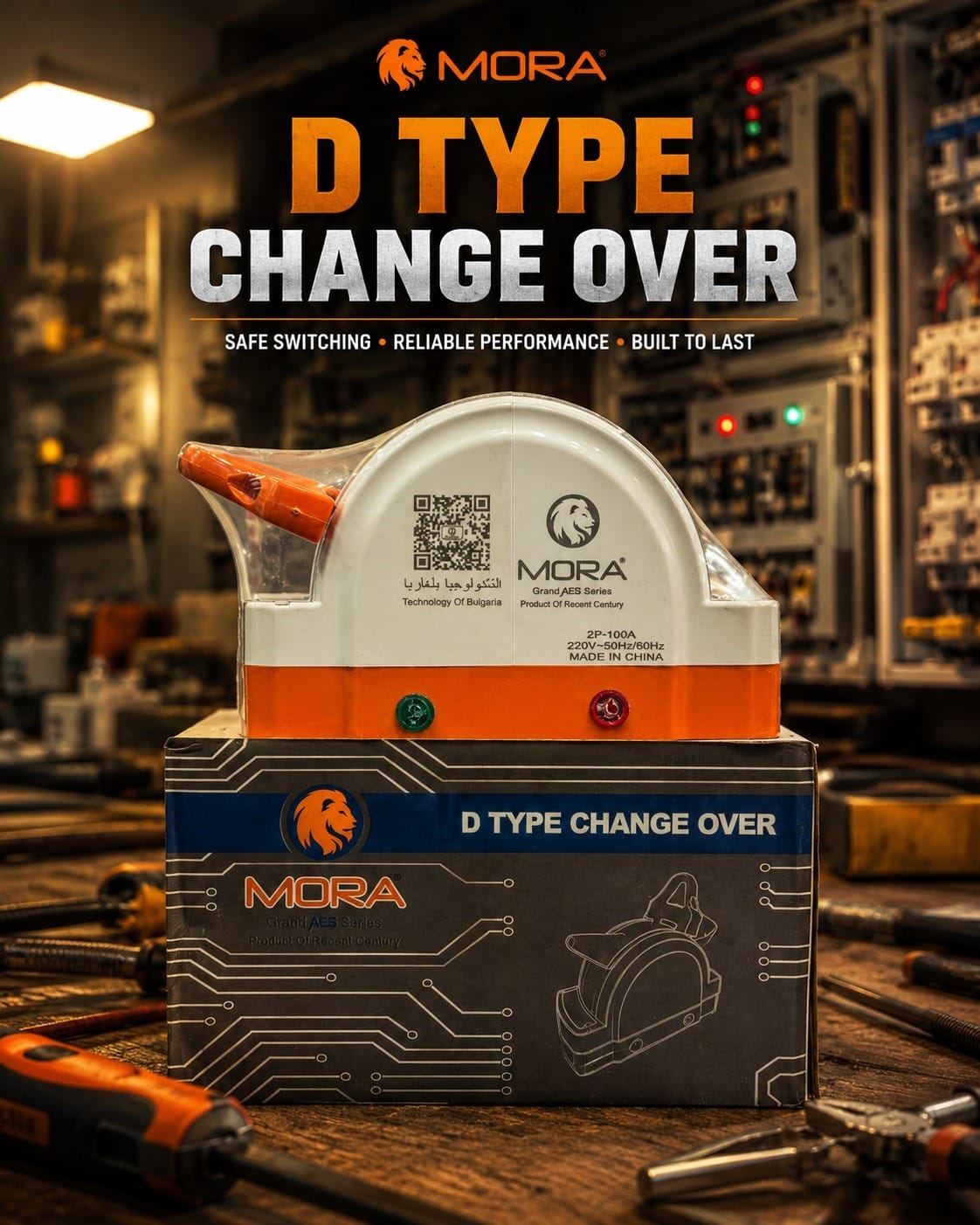
A manual transfer / changeover switch (MTS) does the same isolation with a lever or rotary handle. Someone must be present. For homes that already have a hybrid inverter’s built-in EPS relay, a small manual bypass changeover is often more useful than a second automatic unit on the same circuit.
Neither device replaces overcurrent protection. Every source still needs its own MCB or MCCB ahead of the ATS, and the solar DC side still needs a proper DC isolator or DC breaker plus SPD — see also earthing for solar system Pakistan.

Hybrid Built-In Transfer vs External ATS vs Manual Changeover
| Question | Hybrid inverter (EPS / Load out) | External ATS | Manual changeover (MTS) |
|---|---|---|---|
| Who switches? | Internal relay / static transfer on the inverter | ATS control board + motor or solenoid | You, with a lever or rotary |
| Typical transfer time | Often ~10–20 ms on Tier-1 hybrids (UPS-like for critical loads) | Usually ~0.5–3 s after sensing + programmed delay | As long as it takes you to reach the box in the dark |
| Best Pakistan use | Everyday load-shedding on fans, lights, fridge, Wi-Fi, one AC on EPS | Generator auto-start; on-grid inverter + separate UPS; unattended shops | Service bypass; small homes where someone is always home |
| Backfeed protection | Inverter isolates grid input when islanded — if installed correctly | Mechanical interlock keeps Source 1 and Source 2 apart | Same interlock, but only if you never force both sides |
| When it is the wrong buy | Expecting the whole house (every AC + geyser + pump) on a small EPS rating | Stacking a second ATS on the same hybrid EPS wires “just in case” | Leaving an elderly household to flip a switch during every outage |
When You Do — and Do Not — Need an External ATS
- Modern hybrid with Grid IN + Load/EPS OUT: for those EPS loads, the inverter is the transfer switch. Do not put another ATS in series on the same EPS feed unless the manufacturer’s diagram requires it for a generator.
- On-grid (grid-tied) inverter + separate battery UPS: yes — an external ATS or changeover must isolate the grid-tied path and hand critical loads to the UPS. Without it, you risk paralleling two AC sources.
- Solar + grid + generator: yes — this is the classic external ATS job. Many hybrids accept generator on the AC input or a dedicated GEN port; if not, an ATS selects WAPDA vs generator ahead of the inverter’s grid terminals. Poultry and long evening outages are covered in the poultry ATS guide.
- Service bypass: a manual 2P/4P changeover that can feed the critical-load DB straight from WAPDA while the inverter is locked off for repair. Useful even when the hybrid already has EPS.
- Critical-load panel split: some installers put lights/fans/fridge on the hybrid EPS output and leave heavy loads on the grid. That split is by wiring, not by a second ATS on the EPS. An ATS only appears if a second independent AC source must share that panel.

Wiring Diagram Focus: Safe Connections
Topology A — hybrid inverter (most homes)
- WAPDA meter → main MCB → voltage protector → hybrid GRID input.
- Hybrid LOAD / EPS output → critical-load DB (sub-board for essentials).
- PV strings → DC isolator / DC MCB → inverter DC input; AC and DC SPDs to a proper earth — see earthing for solar.
- Optional: manual changeover in parallel as a bypass around the inverter for service — never as a second automatic path that can close both ways at once.
Topology B — external ATS between two AC sources
- Source 1 (WAPDA) through its own MCB → ATS Source 1 terminals.
- Source 2 (inverter AC out, UPS out, or generator) through its own MCB → ATS Source 2 terminals.
- ATS common / load → house DB or critical-load DB.
- Earths bonded at one main earth bar; do not bond the two sources’ neutrals upstream of a switched-neutral ATS.
- Control / sensing supply taken as the ATS maker labels — wrong control feed is a common reason the unit “never moves”.
Authoritative background on transfer-switch function: transfer switch overview. For product-level diagrams always follow the sticker on the ATS and the inverter manual — terminal letters differ by brand.
Worked Example: 5 kW Hybrid Home in Lahore
Ayesha’s DHA Phase 5 house has a 5 kW hybrid inverter, ~10 kWh lithium, and single-phase LESCO. Nameplate on the inverter’s EPS/backup port: 5 kW continuous. Summer evening essentials she wants during load-shedding: 4 ceiling fans (~300 W), LED lights (~200 W), fridge (~200 W average), Wi-Fi/router (~30 W), one 1-ton inverter AC (~900–1200 W running). That is roughly 1.6–2.0 kW — well inside a 5 kW EPS. The geyser, second AC, iron and microwave stay on the non-backup side and go dark in an outage. (Sizing a bigger unit? See can I run a 1.5 ton AC on a solar inverter.)
- Does she need an external ATS for grid ↔ battery? No. The hybrid’s internal transfer already feeds the critical DB from EPS when LESCO drops.
- What should she still buy? A 2P 63A manual transfer / changeover as a service bypass so a technician can lock the inverter off and keep those same loads on WAPDA. Main single-phase breaker and ATS/changeover poles must match the supply (2P for single-phase including switched neutral where required).
- When would she add an automatic ATS? If she keeps a petrol/diesel generator for multi-hour winter fog outages after the battery is low. Then a DIN-rail or boxed ATS selects WAPDA vs generator ahead of the inverter grid input — for example a 2P 63A dual-power ATS on a modest single-phase feed, or a 4P 63A ATS on three-phase.
- Sizing check: ATS continuous current ≥ main breaker rating of the circuit it switches. A 63A main does not belong behind a 40A changeover. Heavy three-phase shops look at 100A / 125A class units such as the 100A 4P motorised ATS.

Pakistan-Specific Mistakes That Cause Damage or Danger
- Backfeeding the street: generator or inverter AC tied to the meter without a break-before-make transfer can energise lines that WAPDA staff think are dead. This is a life-safety issue, not a “warranty void” footnote.
- Two MCBs as a fake ATS: both can be ON. Use a proper changeover or ATS with a mechanical interlock. Browse changeover switches and ATS.
- Undersized poles on summer load: a changeover rated below the main breaker overheats. Match amps and pole count (2P single-phase, 4P three-phase when neutral must switch).
- Neutral mix-ups: separately derived sources often need a switched neutral; solid neutrals with multiple N–E bonds create parallel return paths and odd RCD trips.
- Ignoring return spikes: when load-shedding ends, voltage can overshoot. A voltage protector on the grid leg ahead of the inverter/ATS still earns its keep — see surge & voltage protection.
- Skipping earth: SPD and RCCB performance depend on a real earth pit. Net-metering surveys fail systems with bad earthing — guide linked above.
Step-by-Step: Commissioning Checklist
- Confirm inverter type (hybrid EPS vs on-grid only) from the manual and the terminal labels — not from the sales brochure alone.
- List critical loads in watts; keep them under the EPS or UPS continuous rating with margin for motor starts.
- Decide: built-in transfer only, manual bypass, or external ATS (generator / dual AC sources).
- Size ATS/changeover ≥ circuit main breaker; pick 2P or 4P to match phases and neutral strategy.
- Wire each source through its own MCB; land Source 1, Source 2 and Load exactly as the ATS diagram shows.
- Bond earths at one bar; resolve neutral switching before energising.
- Test by hand (manual lever) for continuity: selected source to load closed; other source open; sources never bonded to each other.
- Test automatic path with a controlled grid isolation (qualified electrician): transfer to Source 2, then retransfer after the return delay.
- Label every position in Urdu/English: WAPDA / SOLAR-UPS / GENERATOR / BYPASS / OFF.
Safety Notes
- Isolate and lock off before opening an ATS, changeover or inverter terminal cover. Prove dead.
- Never defeat an interlock or bridge two sources “sirf ek minute ke liye”.
- Generator exhaust outdoors only; CO kills in closed garages.
- Have a licensed electrician commission any device on the incoming supply. Mistakes here are upstream of the whole house.
Quick Checklist: ATS for Solar and Grid
- ☐ Inverter type confirmed (hybrid EPS vs on-grid)
- ☐ Critical-load list ≤ EPS/UPS continuous rating
- ☐ External ATS only if generator, dual AC sources, or required by the manual
- ☐ Manual bypass considered for inverter service
- ☐ ATS/changeover amps ≥ main breaker; 2P or 4P correct
- ☐ Separate MCBs on each source; no DIY dual-breaker “ATS”
- ☐ Neutrals and earth resolved; no upstream dual N–E bonds
- ☐ DC side still has DC breaker/isolator + SPD + earth
- ☐ Transfer tested both ways; labels fitted
FAQ: ATS for Solar and Grid
Do I need an ATS if I already have a hybrid solar inverter?
Usually no, for the loads on the inverter’s EPS/backup output — that internal transfer already switches those loads when WAPDA fails. You may still want a manual bypass changeover for service, or an ATS if you add a generator.
Can I use an ATS between WAPDA and my hybrid inverter’s EPS output?
Stacking a second automatic transfer on the same EPS wires is rarely useful and easy to wire wrong. Prefer the inverter’s designed path. Use an external ATS when a second independent AC source (generator or separate UPS) must share a panel.
What size ATS for a single-phase Pakistani home?
Match or exceed the main breaker on the circuit you are switching. Many single-phase homes use 40A–63A 2-pole units; three-phase supplies need 4-pole. Do not put a 100A main behind a 63A changeover.
Manual changeover or automatic ATS — which is better with solar?
If someone is home and you only need a bypass or rare generator use, manual is simple and reliable. If the site is unattended, or a generator must auto-start after the battery is low, choose ATS.
Is it safe to plug a generator into a home socket during load-shedding?
No. That is a classic backfeed path onto the neighbourhood lines. Use a proper changeover/ATS and a licensed electrician.
Need a second opinion on your inverter terminals or ATS rating? WhatsApp a clear photo of the inverter label, main breaker and DB to 0329 1654950 — HN Electric, Brandreth Road side. Hum Bata den ge ke external ATS zaroori hai ya sirf bypass changeover kaafi hai.
