
Can I Run 1.5 Ton AC on Solar Inverter? Inverter Size, Panels & Battery (Pakistan)


Short answer: yes, you can run a 1.5 ton AC on a solar inverter in Pakistan — but only if the inverter type matches the time you want cooling. A 1.5 ton inverter AC runs comfortably in daylight on a 4–6 kW solar inverter with roughly 3–4 kWp of panels. An on-grid (net-metering) inverter will NOT run it during load-shedding, because it shuts down when WAPDA/LESCO supply drops. For load-shedding and night cooling you need a hybrid or off-grid inverter plus a correctly sized lithium battery. Non-inverter (fixed-speed) ACs need much more surge headroom.
Instead of one magic number, this guide gives you a method: read the AC nameplate, match the inverter type to your load-shedding pattern, size panels for Pakistani summer heat, add a battery only if you need night cooling, and protect the circuit. Koi bhi system lene se pehle ye 10 minute ka calculation zaroor karein.

Can I Run 1.5 Ton AC on Solar Inverter? It Depends on Three Things
Three questions decide it, in this order:
- What does the AC actually draw? “1.5 ton” is cooling capacity, not electricity. One ton of refrigeration is 12,000 BTU per hour, so a 1.5 ton unit delivers about 18,000 BTU/h (roughly 5.3 kW of cooling). The electrical input is far lower and is printed on the outdoor or indoor unit’s rating plate as “rated input power” or “cooling input (W)”. That watt figure — not the tonnage — is what your inverter must supply.
- Is it an inverter (DC/variable-speed) AC or a fixed-speed AC? Inverter ACs ramp the compressor up gradually, so the starting surge is small and the running power drops once the room is cool. Fixed-speed ACs hit the compressor at full power every time the thermostat calls, with a short but heavy inrush current. That inrush is what trips undersized solar inverters.
- When do you want cooling? Daytime only, during load-shedding, or at night. Each answer points to a different inverter type.
On-Grid vs Hybrid vs Off-Grid: Which Inverter Runs a 1.5 Ton AC During Load-Shedding?
A common complaint: “Mera solar laga hai, phir bhi light jaate hi AC band ho jata hai.” The reason is anti-islanding. An on-grid (grid-tied) inverter is designed to stop exporting the moment grid voltage disappears, so that a line worker repairing the feeder is not electrocuted by your panels. It is a safety feature, not a fault: on-grid systems cut your bill but give zero backup.
| Inverter type | Runs 1.5 ton AC in sunshine? | During load-shedding? | At night? | Best for |
|---|---|---|---|---|
| On-grid / grid-tied (net metering) | Yes, alongside grid | No — shuts down | Grid only | Bill reduction where outages are rare |
| Hybrid, battery-less PV mode (only some models) | Yes, if sun is strong | Only while the sun is strong | No | Daytime cooling on a tight budget |
| Hybrid + lithium battery | Yes | Yes, from PV + battery | Yes, for as long as the battery is sized | Most Pakistani homes with load-shedding |
| Off-grid / UPS-type solar inverter + battery | Yes | Yes | Yes, sized by battery | Areas with long outages or weak supply |
If you already have net metering, adding backup usually means a hybrid inverter or a separate battery inverter feeding a critical-load circuit — speak to your installer before changing anything on the meter side. For the rules on export and billing, check the current regulations directly with NEPRA and see our solar net metering guide for Pakistan.
Inverter Capacity for 1.5 Ton AC: Sizing Table
The inverter must cover two things: the continuous watts of everything running at the same time, and the surge of the biggest motor when it starts. Use this as a planning guide and confirm against the AC nameplate and inverter datasheet (continuous and surge ratings).
| What you want to run together | Inverter AC | Non-inverter (fixed-speed) AC |
|---|---|---|
| One 1.5 ton AC + fans + lights only | 4 kW minimum; 3 kW works only if the AC is nearly the only load | 6 kW class (surge headroom) |
| One 1.5 ton AC + fridge + fans/lights + TV/router | 5–6 kW | 6–8 kW |
| One 1.5 ton AC + water motor (pump starts while AC runs) | 6 kW | 8 kW or stagger the pump |
| Two 1.5 ton ACs | 8 kW or more | 10 kW class, or replace with inverter ACs |
Two practical notes. First, an inverter rated “4 kW” may not hold 4 kW for hours in a 45 °C room; keep it shaded with airflow. Second, evening low voltage on WAPDA does not matter to the AC while it is running from the inverter’s own output, because the inverter generates its own regulated 230 V — but it matters a lot when the inverter is in grid-bypass mode. On many hybrid models you can choose a narrow “UPS” input range so the inverter switches to battery instead of passing very low voltage through to the compressor.
You can browse current single-phase hybrid options in our solar inverters category — for one 1.5 ton AC plus normal home load, the 6 kW class (for example the SolarMax ONYX Ultra 6kW hybrid inverter) gives comfortable headroom.

How Many Solar Panels for 1.5 Ton AC? Step-by-Step Worked Example
Panels are rated at standard test conditions (25 °C cell temperature). On a Lahore or Multan roof in June the cells run much hotter, output drops with temperature, and dust, cable and inverter losses take a further share. For planning, we assume panels deliver around 70–80% of their label rating at midday in summer. Use 0.75 if you have no better data for your roof.
Step 1: Read the nameplate
Example home in Lahore: a 1.5 ton DC inverter AC whose rating plate shows a maximum cooling input of 1,600 W (yours may be higher or lower — use your own figure).
Step 2: Add everything that runs at the same time in the afternoon
- AC at full cooling: 1,600 W (it will often run lower once the room is cool, but size for the hot afternoon)
- Fridge: about 200 W while the compressor runs (check its label)
- Fans, LED lights, TV, Wi-Fi router: about 400 W
Total simultaneous load = 2,200 W.
Step 3: Size the panels
Required panel capacity ≈ 2,200 W ÷ 0.75 ≈ 2,935 W. With 585 W panels that is 2,935 ÷ 585 ≈ 5.0, so plan six panels (about 3.5 kWp) to keep the AC running through late afternoon when the sun angle drops. If you also want to charge a battery during the day, add panels for that energy (Step 5).
Step 4: Size the inverter
2,200 W continuous × 1.25 safety margin = 2,750 W. Round up to the next standard size: 4 kW minimum; choose 6 kW if a water motor, iron or microwave may start while the AC runs. Check that your panel string voltage stays inside the inverter’s MPPT range on cold winter mornings, when panel voltage is highest.
Step 5: Size the battery (only if you need night or load-shedding cooling)
Suppose you want the AC for 4 hours after sunset. Once the room is cool, an inverter AC typically cycles well below its maximum; for this example we assume an average of about 900 W (measure yours with a clamp meter or the inverter app). Add 400 W of fans and lights:
- AC: 0.9 kW × 4 h = 3.6 kWh
- Other loads: 0.4 kW × 4 h = 1.6 kWh
- Total = 5.2 kWh, plus about 10% for inverter losses ≈ 5.7 kWh
If you only discharge the lithium battery to about 80–90% depth of discharge (as most LiFePO4 makers recommend), you need roughly 6.5–7 kWh of nominal battery capacity for those four hours. A single 5 kWh battery will run out early. Then add about 2 kWp of extra panels so the battery can recharge in the day. See our lithium batteries range for 48 V/51.2 V options that pair with hybrid inverters.
Want us to check your numbers? Send a photo of the AC rating plate and your inverter model on WhatsApp and we will run this calculation for you.
1.5 Ton AC on Solar Panel Without Battery: Does It Work?
Yes, in daylight, with conditions. On an on-grid system the AC runs from solar plus grid as long as WAPDA is present; solar simply reduces what you draw from the meter. On a hybrid inverter that supports battery-less operation, the AC can run from panels alone, but every passing cloud cuts power, and the inverter may shut the output off if PV drops below the load. Inverter ACs cope better because they can slow down instead of stalling. If you go battery-less, avoid running pumps at the same time and accept brief stops on cloudy afternoons.
Protection: Wiring a 1.5 Ton AC Safely on a Solar Inverter
An AC compressor is an expensive motor, and a hybrid inverter is an expensive electronic box. Both fail early when protection is skipped. Here is the protection chain we recommend for Pakistani homes:

- PV side: a DC-rated breaker or isolator per string, never an AC MCB on solar DC — see DC isolator vs DC breaker.
- Surge: a DC SPD such as the TOMZN 1000V DC SPD near the inverter, bonded to a proper earth pit (earthing for solar systems). Monsoon lightning surges are a common reason inverters fail.
- Battery: a DC fuse or DC breaker close to the battery terminals, sized to the inverter’s battery current.
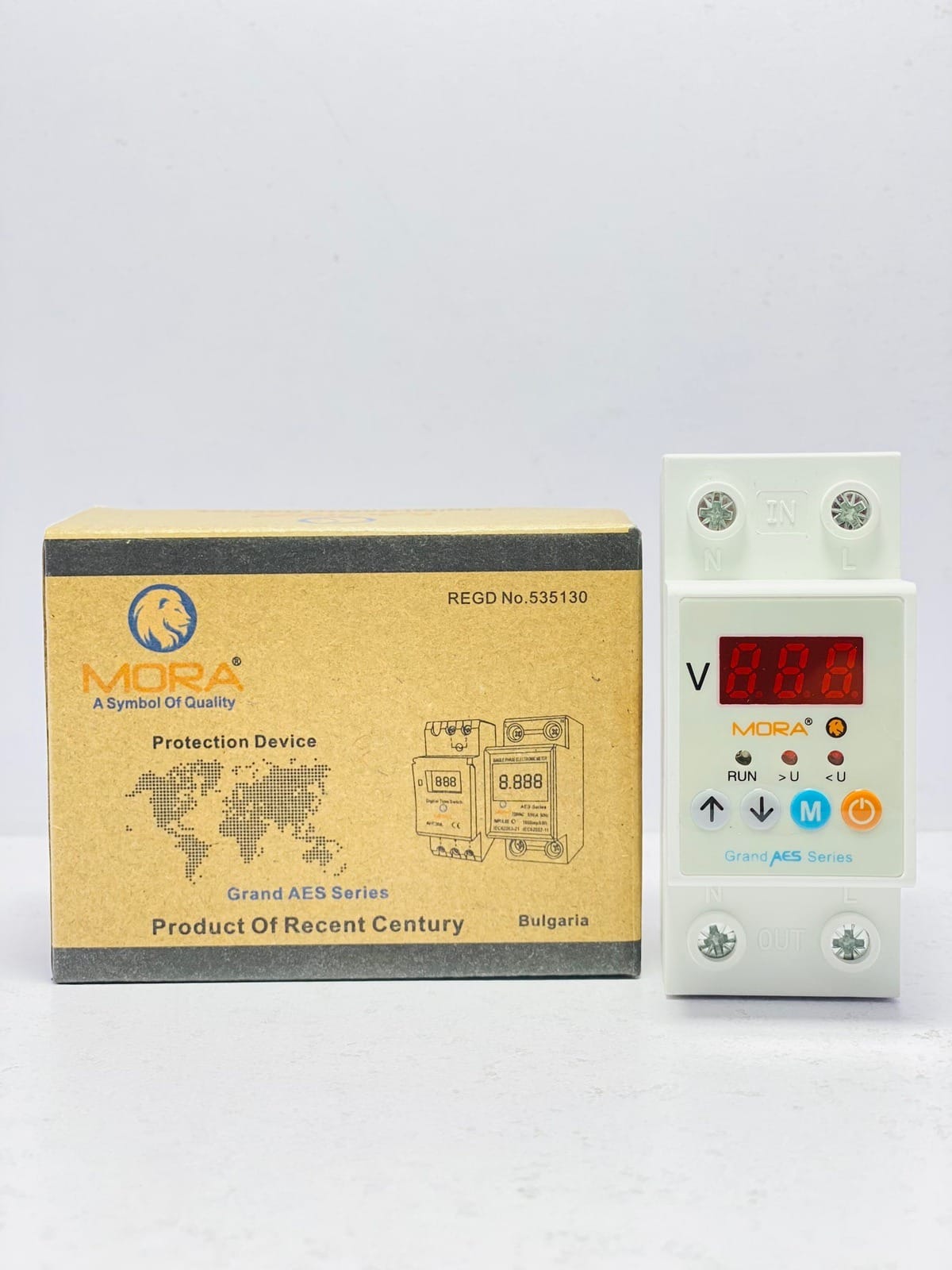
- Grid input: an MCB plus an over/under voltage protector such as the MORA 40A voltage protector, so high-voltage spikes and evening brownouts do not reach the inverter’s grid input or the AC in bypass mode.
- AC circuit: a dedicated MCB and wire sized to the AC’s rated current — our which MCB for 1.5 ton AC guide walks through the nameplate method.
Safety: never connect the inverter’s LOAD/backup output back into the meter-side wiring, and never “parallel” two sources with ordinary breakers. Battery and PV DC can deliver dangerous fault currents — have a qualified electrician do the final connections.
Quick Checklist Before You Buy
- AC rating-plate input watts noted (and whether it is an inverter AC).
- Hours of cooling needed: daytime, load-shedding, night.
- Inverter type chosen to match (on-grid vs hybrid vs off-grid).
- Inverter continuous rating ≥ total simultaneous load × 1.25; surge rating checked.
- Panel kWp = load ÷ 0.75 (plus extra for battery charging).
- Battery kWh from the Step 5 method, not guesswork.
- DC breaker, DC SPD, battery fuse, grid MCB, voltage protector and earthing in the quote.
FAQs: Can I Run 1.5 Ton AC on Solar Inverter?
Can I run a 1.5 ton AC on a 3kW solar system?
A 1.5 ton inverter AC can run on a 3 kW inverter in strong daylight if it is almost the only load, but there is little margin left for a fridge, iron or water motor. For a normal Pakistani home we recommend a 4–6 kW inverter. A non-inverter 1.5 ton AC on 3 kW is likely to trip on start-up.
Can I run a 1.5 ton AC on a 2kW solar system?
Generally not reliably. Two kW of panels will produce noticeably less than 2 kW in summer heat, which is often below a 1.5 ton AC’s full-cooling input. It may work briefly at midday with grid support on an on-grid system, but it is not a dependable standalone setup.
How many solar panels are needed for a 1.5 ton inverter AC in Pakistan?
Divide the AC’s nameplate input watts plus your other simultaneous loads by about 0.75, then by your panel wattage. For a 1,600 W AC plus 600 W of other loads, that is about six 585 W panels (around 3.5 kWp), before adding panels for battery charging.
How much battery is required to run a 1.5 ton AC at night?
Multiply the AC’s average running watts by the hours you need, add other loads and about 10% losses, then allow for depth of discharge. In our worked example, four hours of an inverter AC plus fans and lights needs roughly 6.5–7 kWh of nominal lithium capacity. Full-night cooling needs considerably more.
Why does my AC stop on solar when the light goes?
You almost certainly have an on-grid inverter. It is required to shut down during grid failure (anti-islanding). To keep the AC on during load-shedding you need a hybrid or off-grid inverter with battery, wired to a backup circuit.
Get the Right Inverter, Battery and Protection From HN Electric
Send us your AC rating plate photo, your load-shedding hours and your roof space, and we will suggest the inverter class, panel count, battery size and the protection parts for the AC circuit — no guesswork. WhatsApp HN Electric at 0329 1654950 or browse solar inverters, lithium batteries and surge protection on hnelectric.pk.
For a 1.5 ton AC, a 6 kW hybrid is a common starting point. See the Solis 6kW S6-EH1P6K-L-PLUS (5-year official Solis manufacturer warranty) and confirm surge current and battery size with your installer.
