
Geyser Breaker Keeps Tripping? Causes, Tests & Safe Fixes (Pakistan Guide)


Short answer: if your geyser breaker keeps tripping, first look at which device dropped and when. If the RCCB / ELCB (the switch with a “T” test button) trips the moment the geyser comes on, the heating element is almost always leaking current into the water or tank. If the MCB trips instantly, suspect a short in the element, cable or switch. If the MCB trips only after 10–40 minutes of heating, look for a loose, burnt terminal or an undersized or worn-out breaker. Do not keep resetting it, never fit a bigger breaker, and never bypass the RCCB: the trip is protecting you from a live geyser.
Every winter in Pakistan the same complaint comes in: “geyser on karte hi breaker gir jata hai.” This guide gives you a two-question diagnosis, a cause-by-cause table, safe checks you can do yourself, the tests an electrician should do (with a worked example), and Pakistan-specific causes like load-shedding restarts, damp bathrooms in foggy mornings and UPS neutral mix-ups. It is a troubleshooting companion to our MCB size for geyser guide.
Why a Geyser Breaker Keeps Tripping: Read the Device First
Most online answers list ten causes and stop there. The faster method is to look at the DB box before you reset anything. Different devices trip for different reasons:
- MCB (or the overcurrent side of an RCBO) trips on too much current: an overload or a short circuit. It does not detect leakage to earth.
- RCCB / ELCB (or the leakage side of an RCBO) trips when the current going out on live does not match the current coming back on neutral, meaning some of it is leaking to earth: through a cracked element, wet terminals or, worst case, a person.
- Main switch only usually means the whole house drew more than the main breaker allows, often a geyser plus room heaters plus a kettle running together.
- Nothing in the DB tripped, but the geyser stopped heating: that is the geyser’s own thermal cut-out (high-limit) inside the unit, not your breaker. It usually means the thermostat has stuck on and overheated the water.
If you are not sure what an RCCB or RCBO is, our MCB vs MCCB vs RCCB vs RCBO comparison explains each one with a DB box diagram.

Geyser MCB Tripping vs RCCB Tripping: Cause Table
Use this table together with the chart above. It is based on how the protective devices work, not on brand claims.
| What you see | Device that trips | Most likely cause | What to do |
|---|---|---|---|
| Trips the instant the geyser switch goes on | RCCB / ELCB / RCBO (leakage) | Cracked element sheath leaking into water or tank | Leave it off. Electrician to insulation-test and replace the element |
| Trips the instant the geyser switch goes on | MCB | Dead short: element burst, cable damaged, switch carbonised | Do not reset again. Isolate and test the cable and the element separately |
| Trips after 10–40 minutes of heating | MCB | Loose or burnt terminal heating the MCB, an undersized MCB, or an old, weak breaker | Check the MCB rating against the geyser plate; tighten or replace the terminals and the breaker |
| Trips only on cold, damp mornings or after a bath | RCCB | Moisture in the terminal box, the plug or a bathroom switch | Dry and seal the box, move the switch outside the wet area, check the gasket |
| Water is scalding and the geyser stops, but the DB is fine | Geyser cut-out (inside the unit) | Thermostat stuck on | Replace the thermostat. Never bridge the cut-out |
| RCCB trips even with the geyser switched off | RCCB | Leak on another circuit, or a shared or borrowed neutral | Switch the MCBs off one by one to find the circuit. Check the neutrals |
| Main switch trips in the evening when everything runs | Main MCB | Total winter load is above the main rating | Stagger the loads or split circuits. Get the main and incoming cable checked |
| Trips when power returns after load-shedding | Main or RCCB | All the geysers and heaters restart together, plus switching surges | Switch heavy loads off during load-shedding and bring them back one by one |
| Trips only on UPS / inverter supply | RCCB | UPS output neutral mixed with the WAPDA neutral, or a neutral-earth link in the wrong place | Electrician to rewire the UPS neutral correctly |
A Common Myth: “Low Voltage Makes the Geyser Trip the MCB”
Some websites say the MCB trips in the evening because low voltage makes the geyser draw more current. For a plain heating element that is wrong. An element is a fixed resistance, so current = voltage ÷ resistance. When LESCO or other DISCO voltage drops from 230 V to, say, 190 V, the element draws less current and heats more slowly. Low voltage hurts motors and compressors, not a resistive geyser. If your geyser MCB trips in the evening, look for heat at a loose terminal or for an overloaded shared circuit instead. Low voltage is not the cause. (A voltage protector is still worth fitting for your fridge, AC and water motor; see our surge and voltage protection range.)
Step-by-Step: How to Find Why Your Geyser Breaker Keeps Tripping
Steps 1–4 are safe for a homeowner. Steps 5–7 need a qualified electrician with an insulation tester (megger) and a multimeter.
- Do not reset straight away. Note which device is down: the MCB handle, the RCCB or the main switch. Take a photo of the DB.
- Switch the geyser off at its DP switch (if it is dry and you can reach it safely), then reset the breaker. If it holds with the geyser off and drops when you switch the geyser on, the fault is on the geyser side.
- Look and smell. Check for water dripping near the terminal cover, a brown or melted switch, a burning smell or a warm DB cover near that MCB. Any of these is a reason to stop and call an electrician.
- Read the geyser rating plate (watts) and the number on the MCB. Amps = watts ÷ 230. A 2,000 W geyser is about 8.7 A, so a 16 A MCB is fine. A 4,500 W instant geyser is about 19.6 A, and a 16 A MCB on it will trip after some minutes as designed. The full sizing chart is in our geyser MCB size guide.
- Electrician: isolate and measure element resistance. With power off and the element wires disconnected, a healthy element reads close to its expected value: R = 230² ÷ watts. An open circuit means the element is dead. A reading near 0 Ω means it is shorted.
- Electrician: insulation test element to tank/earth at 500 V DC. A healthy element reads in the megohms. A low or falling reading (below about 1 MΩ) means water has got into the sheath and the element is causing your RCCB trips.
- Electrician: test the cable and the switch on their own. If the element tests fine, insulation-test the cable from the DB to the geyser and check the MCB terminals for discolouration. Old MCBs that have run hot for years can trip early. Replace them; do not upsize.
Worked Example: 2 kW Geyser in a Lahore House
Ahmed’s storage geyser is rated 2,000 W and sits on a 16 A MCB behind a 30 mA RCCB. The RCCB trips within a second of the geyser switching on, but only in the mornings.
- Expected element resistance: 230 × 230 ÷ 2000 ≈ 26.5 Ω. The meter reads 26.8 Ω, so the coil itself is intact (no short or open).
- Current check: 2000 ÷ 230 ≈ 8.7 A, well under 16 A, so the MCB is correctly sized and is not the issue.
- Insulation test (element to tank) at 500 V DC: 0.3 MΩ cold. That is low, so the element sheath is leaking.
- Why only mornings: overnight the element cools and moisture creeps into the crack. A 30 mA RCCB may trip anywhere from 15 to 30 mA. The morning leakage, added to normal background leakage from the other appliances on the same RCCB, pushes it over the limit.
- Fix: replace the element and gasket, re-test above 1 MΩ, and move the geyser to its own 16 A 30 mA RCBO so a future leak trips only the geyser, not half the house.

Pakistan-Specific Reasons a Geyser Trips the Breaker
Damp bathrooms and foggy winter mornings
In Punjab’s fog season, bathrooms often stay damp all day. Steam gets into geyser terminal boxes, roof-mounted geysers sit in the rain, and switches are often fitted inside the bathroom. If the RCCB trips mostly in the morning or after a long shower, moisture is the first suspect. Keep the DP switch outside the wet area and make sure the terminal cover and its gasket are intact.
Load-shedding restarts
When the light comes back after load-shedding, every geyser thermostat and room heater calls for heat at the same moment because the water and rooms have cooled. That sudden combined load, plus switching surges, can drop the main breaker or the RCCB. Switch heavy heaters off during an outage and bring them back one at a time.
UPS and solar wiring mix-ups
Many homes added UPS or solar inverter circuits later. If a UPS neutral has been joined to the WAPDA neutral of an RCCB-protected circuit, the RCCB sees unbalanced current and trips, even though the geyser is healthy. If tripping happens only on UPS or solar supply, have the neutral routing checked. Our RCBO vs RCCB guide covers shared neutrals and the leakage budget in detail, and good earthing for solar systems matters for the same reason.
Hard water and scale
In areas with hard water, scale builds up on the element. The element then runs hotter inside its sheath, which speeds up cracking. Draining and descaling the tank when you service the geyser helps the element last longer.
The Right Protection So a Geyser Fault Trips Only the Geyser
The best layout for a Pakistani home is simple: give the geyser its own circuit with a 30 mA RCBO (or its own MCB fed from a 30 mA RCCB), sized from the geyser’s rating plate, with a proper earth wire to the tank. Then a leaking element switches off only the geyser circuit, and you keep lights and fans.
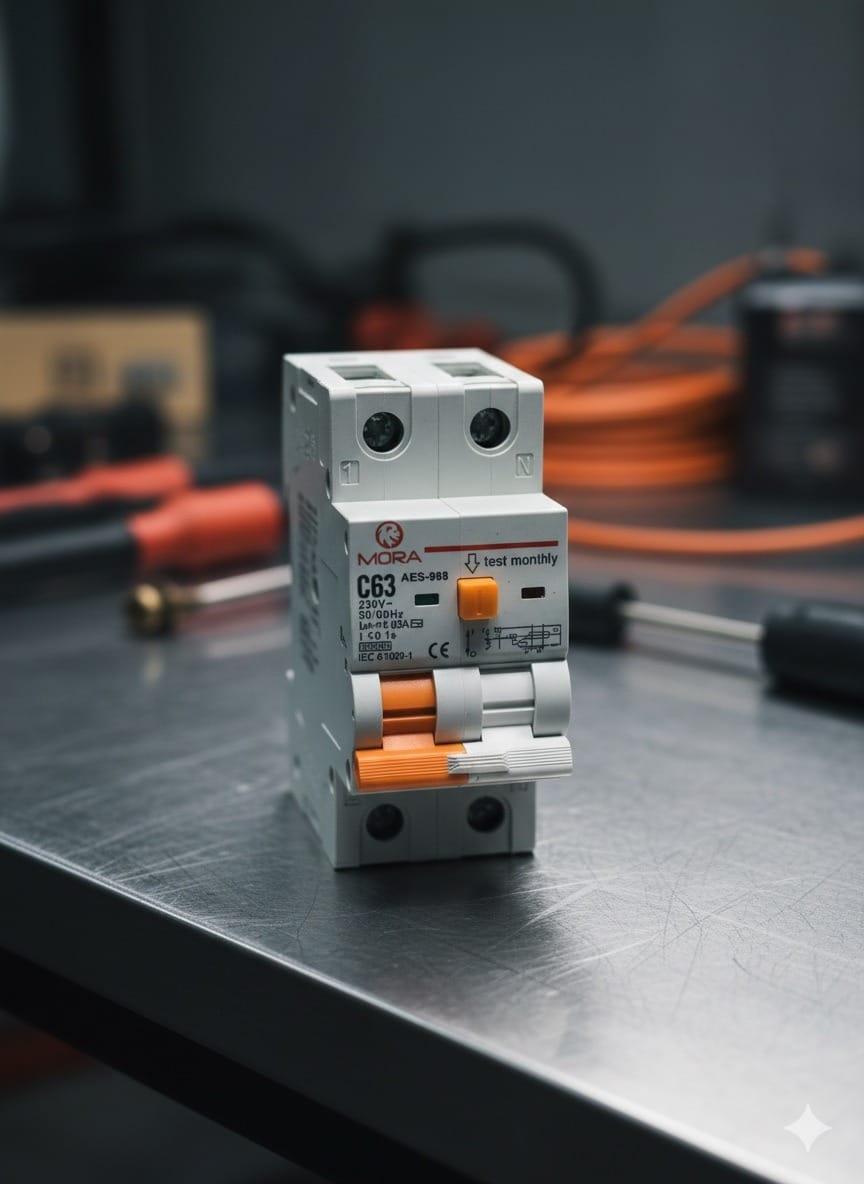
| Setup | Leakage protection | What a leaking geyser switches off | Verdict |
|---|---|---|---|
| MCB only, no RCCB | None | Nothing until it becomes a dead short. The tank can stay live | Unsafe |
| One RCCB for the whole house + geyser MCB | Yes (shared) | The whole RCCB group: lights, fans, sockets | Safe but nuisance-prone |
| Geyser on its own 30 mA RCBO | Yes (per circuit) | Only the geyser | Best for homes |
| Bigger MCB “so it stops tripping” | No change | Nothing. The cable can overheat instead | Never do this |
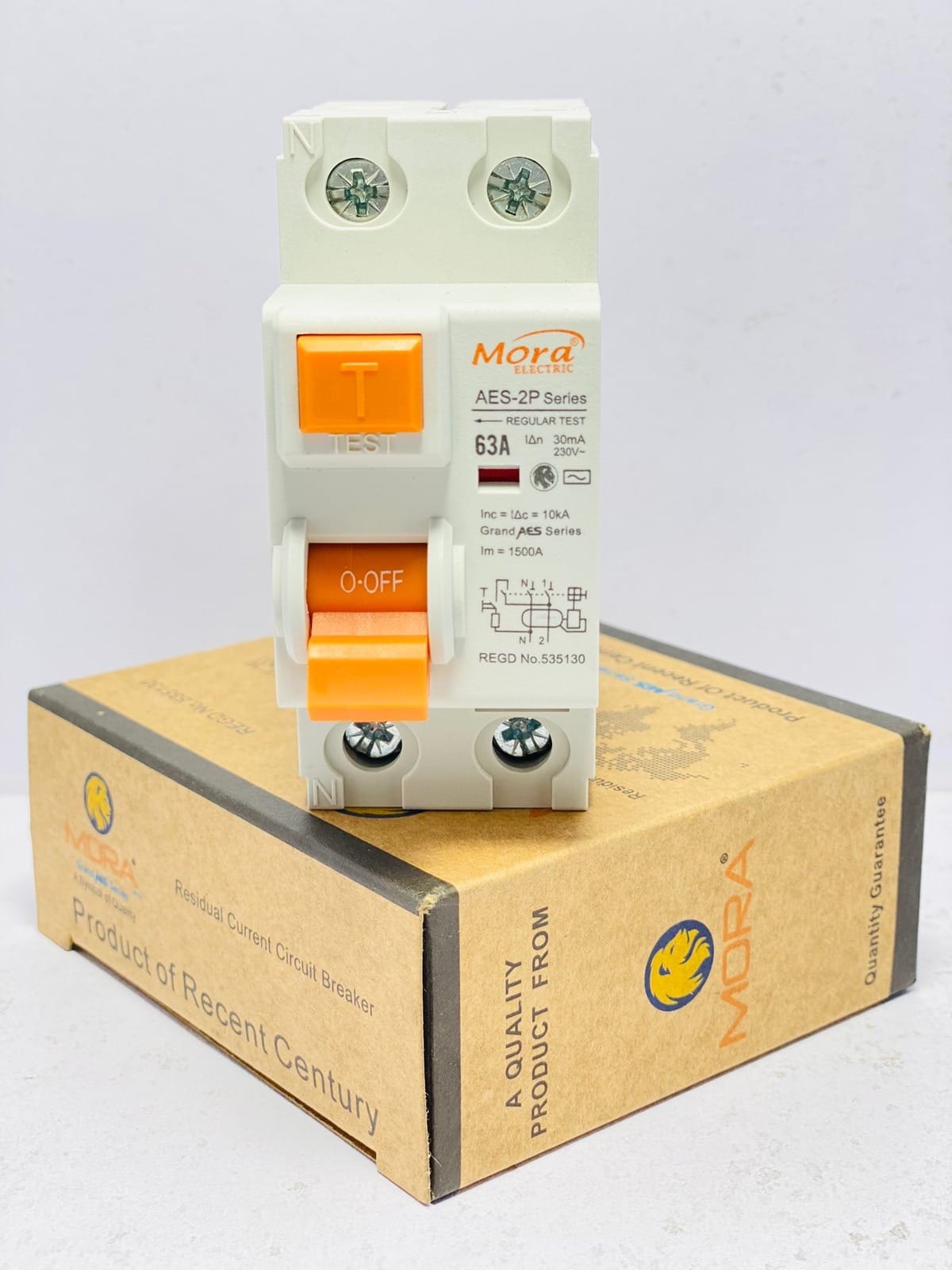
HN Electric stocks the MORA 2P RCBO, the Mora 2P RCCB 63A, more options in our earth leakage breakers range, and Casmo Indigo MCBs in all the common ratings. You can see everything in our circuit breakers category.
Safety Rules When the Geyser Trips the MCB or RCCB
- Never bypass or bridge an RCCB, ELCB or RCBO. A leaking element with no leakage protection can make the water, the tap or the tank live.
- Never “upgrade” a 16 A MCB to 32 A to stop the trips. The breaker protects the cable. A larger breaker lets the wire overheat inside the wall.
- Never bridge the geyser’s thermostat or thermal cut-out. A stuck thermostat with no cut-out can overheat and over-pressurise the tank.
- Do not touch the geyser or its switch with wet hands or while standing in water. Switch off at the DB first.
- Make sure the tank has an earth wire. Without one, a leak may not trip the RCCB until someone becomes the path to earth. The residual-current device article explains why the earth path matters.
- Use a qualified electrician for any work inside the DB or the geyser terminal box.
Quick Checklist: Geyser Breaker Keeps Tripping
- ☐ Noted which device tripped (MCB, RCCB/ELCB, main or geyser cut-out)
- ☐ Noted when it trips (instantly, after minutes, mornings, after load-shedding, on UPS)
- ☐ Geyser off at its switch: does the breaker hold?
- ☐ Checked the rating plate watts ÷ 230 against the MCB rating
- ☐ No water, burn marks or smell at the terminal box, switch or DB
- ☐ Electrician tested the element resistance and insulation (above 1 MΩ)
- ☐ Geyser on its own circuit with a 30 mA RCBO and an earth wire to the tank
- ☐ No bypassed RCCB, no oversized MCB, no bridged thermostat
FAQ: Geyser Breaker Tripping
Why does my geyser trip the RCCB as soon as I switch it on?
An instant RCCB or ELCB trip almost always means earth leakage. Most often the heating element’s metal sheath has cracked and current is leaking into the water and tank. Moisture in the terminal box is the next most likely cause. Leave it off and have the element insulation-tested and replaced if it reads low.
Why does my geyser MCB trip after some time and not immediately?
A delayed MCB trip points to heat, not a short. Usually it is a loose or burnt terminal at the MCB or the switch, an MCB rated too low for the geyser’s watts, or an old breaker that has weakened. Check the rating plate against the MCB, then have the terminals tightened or the breaker replaced with the correct size.
Can I use a bigger MCB to stop the geyser breaker from tripping?
No. The MCB is sized to protect the cable. Fitting a bigger MCB lets the cable overheat and can start a fire, and it does nothing for leakage trips. Size the MCB from the geyser’s watts and the wire size, and fix the real fault.
Does low voltage make an electric geyser trip the breaker?
Not by itself. A geyser element is a resistance, so at lower voltage it draws less current, not more. Evening trips are usually caused by a loose connection, a shared overloaded circuit or the total house load hitting the main breaker.
Geyser trip hone par kya karein? (What should I do when the geyser trips?)
Breaker ko baar baar on na karein. Pehle dekhein kaunsa breaker gira hai, geyser ka switch band kar ke breaker on karein, aur agar geyser on karte hi dobara gire to electrician se element check karwayein. Never bypass the RCCB.
Need the Right Breaker for Your Geyser Circuit?
Send a photo of your DB box and your geyser’s rating plate on WhatsApp and we will suggest the right MCB, RCCB or RCBO for your circuit, with original stock and delivery across Pakistan. WhatsApp HN Electric: 0329 1654950.
