DC Isolator vs DC Breaker: Difference, Placement & Which Your Solar System Needs (Pakistan)


Short answer: a DC isolator is a manual switch that safely cuts solar DC power for maintenance or emergencies, but it never trips by itself. A DC breaker (DC MCB or DC MCCB) trips automatically on overload or short circuit. They do different jobs, so most rooftop solar systems in Pakistan need both: a DC breaker for protection and a DC isolator for safe isolation.
Many customers ask us: “Bhai, DC breaker laga hua hai, to isolator ki kya zaroorat?” Or the opposite: “Isolator lag gaya, ab breaker kyun?” This guide answers the dc isolator vs dc breaker question properly, with a comparison table, a placement diagram, a worked example for a typical Pakistani home system, and a buying checklist.
What Is a DC Isolator?
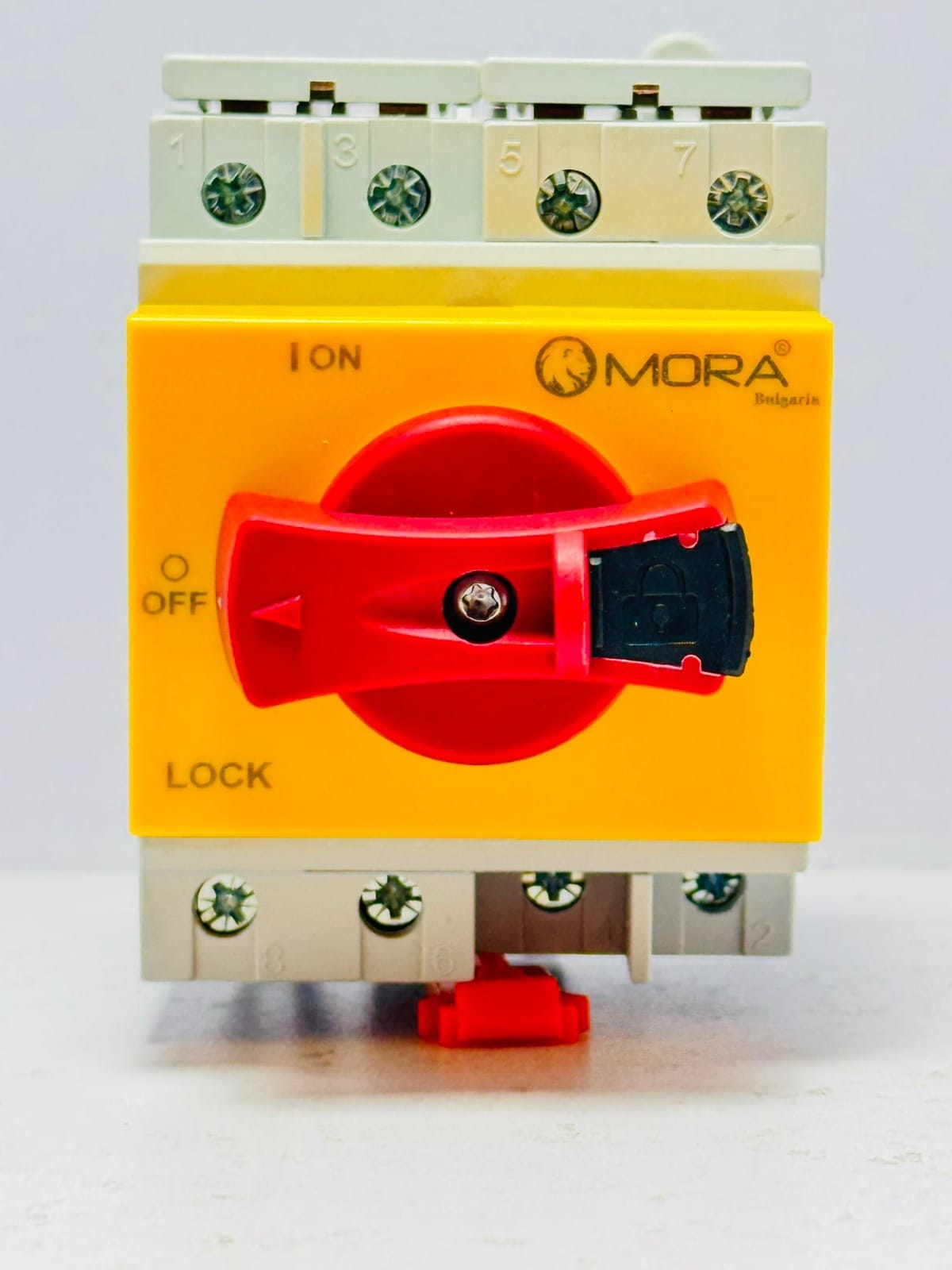
A DC isolator (also called a DC isolator switch, DC disconnect or switch-disconnector) is a manually operated switch built to open a DC circuit and hold it safely open. On a solar system it lets you disconnect the PV strings from the inverter before cleaning, inverter replacement, rewiring or in an emergency such as a fire.
- Manual only: it switches when you turn the handle, not when there is a fault.
- Visible OFF position: good isolators show a clear ON/OFF and many can be padlocked in OFF.
- Load-break rated: quality solar isolators are designed to break DC load current, which is harder than AC because DC has no zero crossing to put out the arc.
- Standard: switch-disconnectors fall under the IEC 60947-3 family. Look for a DC-PV utilization category (DC-PV1 or DC-PV2) on the datasheet.
Example from our range: the Mora AESPV32 IP66 solar DC isolator switch for outdoor/rooftop use, and the MORA DIN rail DC isolator switch 1200V for inside a solar DB.
What Is a DC Breaker?
A DC breaker is a circuit breaker rated for direct current. In small solar systems it is usually a 2-pole DC MCB (often 500V or 1000V DC); for batteries and large currents it is a DC MCCB. It has thermal (overload) and magnetic (short-circuit) trip elements, so it opens on its own when the current goes too high, and you can also switch it by hand.
- Automatic protection: protects cables and equipment against overcurrent and short circuits.
- Polarity matters: many DC MCBs are polarity-marked (+/−). Wiring them backwards can stop them from breaking the arc properly.
- Standard: breakers fall under IEC 60947-2 (industrial) or IEC 60898-2 (DC MCBs for household-type use).
Example: the Mora 2P DC 1000V solar MCB for string protection, or the Mora 2P 250A DC MCCB for the battery side.

DC Isolator vs DC Breaker: Comparison Table
| Point | DC Isolator (switch-disconnector) | DC Breaker (DC MCB / MCCB) |
|---|---|---|
| Main purpose | Safe, deliberate isolation | Automatic overcurrent & short-circuit protection |
| Trips on a fault? | No | Yes |
| Can switch by hand? | Yes (its main job) | Yes |
| Standard family | IEC 60947-3 | IEC 60947-2 / IEC 60898-2 |
| Key ratings to check | DC voltage, current, DC-PV category, poles, IP rating | DC voltage, current, breaking capacity (kA), curve, polarity |
| Typical location | Near array (rooftop) and/or at inverter DC input | Per string or combiner output; battery cable |
| Lock in OFF | Common (padlockable handle) | Only with a lock-off accessory or specific model |
| Replaces the other? | No – it gives no overcurrent protection | Only if the product is also rated & marked for isolation |

Why the Difference Matters on a Solar System
Solar panels keep producing voltage whenever there is daylight. You cannot “switch off the sun”, so the only way to work safely on the DC side is to open the circuit with a device designed for it. That is the isolator’s job.
Faults are a different problem. A damaged cable on a hot roof, water inside an MC4 connector, or a reversed string can cause fault current. Where several strings run in parallel, current from the healthy strings can feed back into a faulty one. A DC breaker or fuse sized for the string protects against that. An isolator will just sit there and do nothing.
In Pakistan, roofs regularly get above 60–70°C in June, dust storms are common, and many systems are installed in a hurry. A DC device that is not rated for the job (for example an AC breaker used on DC) is one of the most common causes of melted DBs that we see from customers.
Where Each Device Goes: Placement Diagram

A common layout for a home hybrid or on-grid system is:
- PV strings on the roof.
- DC isolator near the array (rooftop, IP65/IP66) and/or close to the inverter, so the DC cable can be made safe from either end.
- DC breaker (or DC fuse) per string or at the combiner output in the solar DB.
- DC SPD for lightning/surge protection, with a proper earth — see our guide to earthing for solar systems in Pakistan.
- Inverter DC input. Many inverters include a built-in DC switch; check the manual before deciding you need an extra one.
On the battery side, use a DC MCCB or DC fuse sized for the battery cable, plus a way to isolate the battery. Battery short-circuit currents are very high, so breaking capacity matters most here.
The exact order depends on your inverter and installer’s design. See our solar distribution box guide for full DB layouts.
Worked Example: Typical Pakistani Home System
Take a hybrid inverter with 2 strings, each string with panels in series giving roughly 400–480V open-circuit voltage on a cold morning, and an operating current around 13–14A per string (check your panel datasheet for Isc and Voc).
- Isolator: one 2-string or 4-pole DC isolator rated above the cold Voc (a 1000V or 1200V DC model gives margin) and above the string current, mounted near the inverter or on the roof.
- Breaker: one 2-pole DC MCB per string, rated for at least the system DC voltage, with current chosen from Isc × 1.25 rounded up to the next standard size, and never above the panel’s maximum series fuse rating or the cable rating.
- SPD: one DC SPD rated for the system voltage, earthed.
For the detailed current and voltage maths, see our DC breaker size for 10kW solar system worked example and the DC circuit breaker selection guide.
Can a DC Breaker Replace a DC Isolator?
Sometimes, but not by default. A DC breaker can act as the disconnect only if it is rated for the full DC voltage, clearly shows its OFF position, is suitable for isolation (check the datasheet and markings), and can be locked off where your installer or code requires it. If any of that is unclear, fit a separate isolator. Isolators are also usually easier to reach and operate safely in an emergency.
Can a DC Isolator Replace a DC Breaker?
No. An isolator gives no overcurrent or short-circuit protection. Where string or battery protection is needed, you need a DC breaker or DC fuse as well.
Buying Checklist
- DC voltage rating above your cold-morning string Voc (not just the nameplate Vmp).
- Current rating above the string or battery current with margin.
- Isolator: DC-PV1 (single string) or DC-PV2 (parallel strings) category; IP65/IP66 if outdoors.
- Breaker: DC-rated (never an AC MCB on PV), correct polarity, enough breaking capacity (kA) — especially on batteries.
- Correct number of poles for your system.
- Proper enclosure, ferrules and torqued terminals; loose DC terminals overheat.
- Pair with a DC surge protection device and a good earth.
Safety Notes
- Open the DC isolator before touching inverter DC terminals, and remember the cable from the roof stays live in daylight up to the isolator.
- Never pull MC4 connectors under load.
- Use only DC-rated devices on the PV and battery side.
- Get a qualified installer for design and commissioning; follow the inverter manufacturer’s instructions.
FAQ: DC Isolator vs DC Breaker
Is a DC isolator required if my inverter has a built-in DC switch?
Many inverters include a DC switch at their input. An extra isolator near the array is still useful when the roof run is long, or if your installer’s design or local rules ask for isolation at the array. Check your inverter manual.
Can I use an AC isolator or AC breaker on solar DC?
No. DC arcs are harder to extinguish than AC arcs, so AC devices can fail to break DC current and overheat. Always use devices rated for DC at your system voltage.
What is the difference between a DC isolator and a DC disconnect?
In everyday use they mean the same thing: a switch to isolate the DC circuit. On datasheets, check whether it is a disconnector (isolation only) or a switch-disconnector (can break load current). For solar, choose a load-break switch-disconnector.
Do I need a DC breaker for a single string?
With one string, string-level overcurrent protection is often not needed because the panels cannot push much more than their own short-circuit current. A DC breaker is still commonly used for convenient switching and cable protection. With three or more strings in parallel, string protection becomes important.
What size DC isolator do I need?
Choose a voltage rating above the coldest-morning Voc of the string and a current rating above the string’s short-circuit current with margin. For most home systems a 1000V or 1200V DC isolator with a suitable current rating gives safe headroom.
Choosing an isolator? See our solar DC isolator switch buying guide and why an IP66 DC isolator matters for outdoor arrays.
Get the Right DC Isolator and Breaker
HN Electric stocks DC isolators, DC MCBs, DC MCCBs and SPDs for solar systems across Pakistan. Browse solar products or send us your panel and inverter details on WhatsApp 0329 1654950 and we’ll suggest the right combination.
Further reading: Specifying a DC switch-disconnector for solar PV (Professional Electrician).
