
DC Breaker Size for 10kW Solar System: Worked Example & Sizing Table (Pakistan)


Short answer: there is no single “10kW DC breaker”. A 10kW solar system usually has 18 to 24 panels split into two or more strings, and each string needs its own DC breaker, sized from the panel datasheet, not from the kW figure. With today’s 575–600 W panels (short-circuit current around 14 A), a practical choice is a 2-pole, 1000 V DC MCB of 20 A or 25 A per string. If two strings are joined in parallel before the inverter, the shared breaker needs about 40 A. A 48 V hybrid battery needs a much bigger DC MCCB, often in the 200–250 A class, sized from the inverter’s maximum battery current. And on cold winter mornings string voltage rises, so a 9- or 10-panel string can go past a 500 V breaker’s limit.
Below is a real 10kW worked example so you can check your installer’s quote. For DC protection basics, see our DC circuit breaker for solar selection guide; here we focus only on DC breaker size for a 10kW solar system in Pakistan: string, battery and AC side.
DC breaker size for 10kW solar system: quick sizing table
The table below uses an example panel of 585 W with Voc 52 V, Isc 14 A and a Voc temperature coefficient of −0.25 %/°C. These are typical datasheet-style values for modern N-type panels, not a specific brand. Always repeat the maths with your own panel’s datasheet.
| 10kW layout | Where the breaker sits | Current it must carry | Practical DC breaker | Voltage class |
|---|---|---|---|---|
| 2 strings of 9 panels, each on its own MPPT | One per string (2 total) | 14 A per string | 2P DC MCB 20–25 A each | 1000 V (9 panels can pass 500 V in winter) |
| 2 strings of 9 joined in parallel on one MPPT | One after the joint | 28 A combined | 2P DC MCB about 40 A | 1000 V |
| 3 or more strings in parallel | Fuse or breaker per string + main | 14 A per string, 42 A+ combined | String fuses / DC MCBs + DC MCCB main | 1000 V |
| 1 long string of 18 panels (three-phase on-grid) | One for the string | 14 A | DC breaker 20–25 A | Check: about 1018 V at −10 °C, over 1000 V |
| 48 V lithium battery on a 10kW hybrid | Battery to inverter | Inverter’s max battery current (can be near 200 A) | 2P DC MCCB, often 200–250 A class | Low voltage, but very high fault current |
| AC output, three-phase 10kW | Inverter to DB | About 14.4 A per phase | 4P AC MCB as per inverter manual (often 20–25 A) | 400 V AC |
| AC output, single-phase 10kW | Inverter to DB | About 43.5 A | 2P AC MCB as per inverter manual (often 50–63 A) | 230 V AC |
The “10kW” number never decides the breaker on its own: string wiring does.

Why kW alone gives the wrong breaker
Three simple rules explain almost every sizing mistake we see in Pakistan:
- Panels in series add voltage, not current. Nine panels of 14 A in a string still give 14 A, not 126 A. The string voltage goes up instead.
- Strings in parallel add current. Two 14 A strings joined together give 28 A on the shared cable and breaker.
- Cold raises voltage. Panel voltage is highest on a cold, bright morning. The datasheet Voc is measured at 25 °C, but a December morning in Lahore, Islamabad or Quetta can be far colder than that.
Many online tables were written when 330–420 W panels with 10–12 A current were common. Today most Pakistani installs use 575 W and larger panels with 13–14 A or more, so an old “16 A per string” rule can sit too close to the real current. Bifacial panels on a bright roof can also push current above the datasheet figure.
How to calculate DC breaker size for a solar system: 6 steps
Step 1: Read four numbers from the panel datasheet
From the datasheet or the panel’s back label, note: Voc (open-circuit voltage), Isc (short-circuit current), the temperature coefficient of Voc (usually around −0.25 to −0.30 %/°C on modern panels), and the maximum series fuse rating. That is the largest protection device allowed on its string.
Step 2: Count strings and MPPT inputs
From the inverter datasheet, note the number of MPPTs, maximum DC input voltage and maximum current per MPPT. Decide if each string gets its own MPPT or two strings share one.
Step 3: Correct the voltage for your coldest morning
Use this simple formula:
Cold string Voc = panels in series × Voc × (1 + coefficient × (25 − lowest temperature))
Use the coefficient as a positive number here (0.25 % = 0.0025). The breaker’s DC voltage rating and the inverter’s maximum input voltage must both be above this cold value.
Step 4: Calculate the current rating
For a single string: Isc × 1.25 is the common minimum used by installers. The US electrical code (NFPA 70, NEC) uses Isc × 1.25 × 1.25 = Isc × 1.56 for overcurrent devices, and the IEC solar array standard (IEC 62548) asks for string protection to be rated above 1.5 × Isc. For strings in parallel, multiply by the number of strings first. Round up to the next standard size.
Step 5: Check the upper limit
The breaker must not be larger than the panel’s maximum series fuse rating, and it must not be larger than the current the cable can safely carry. A breaker that is too big protects nothing.
Step 6: Check breaking capacity, poles and polarity
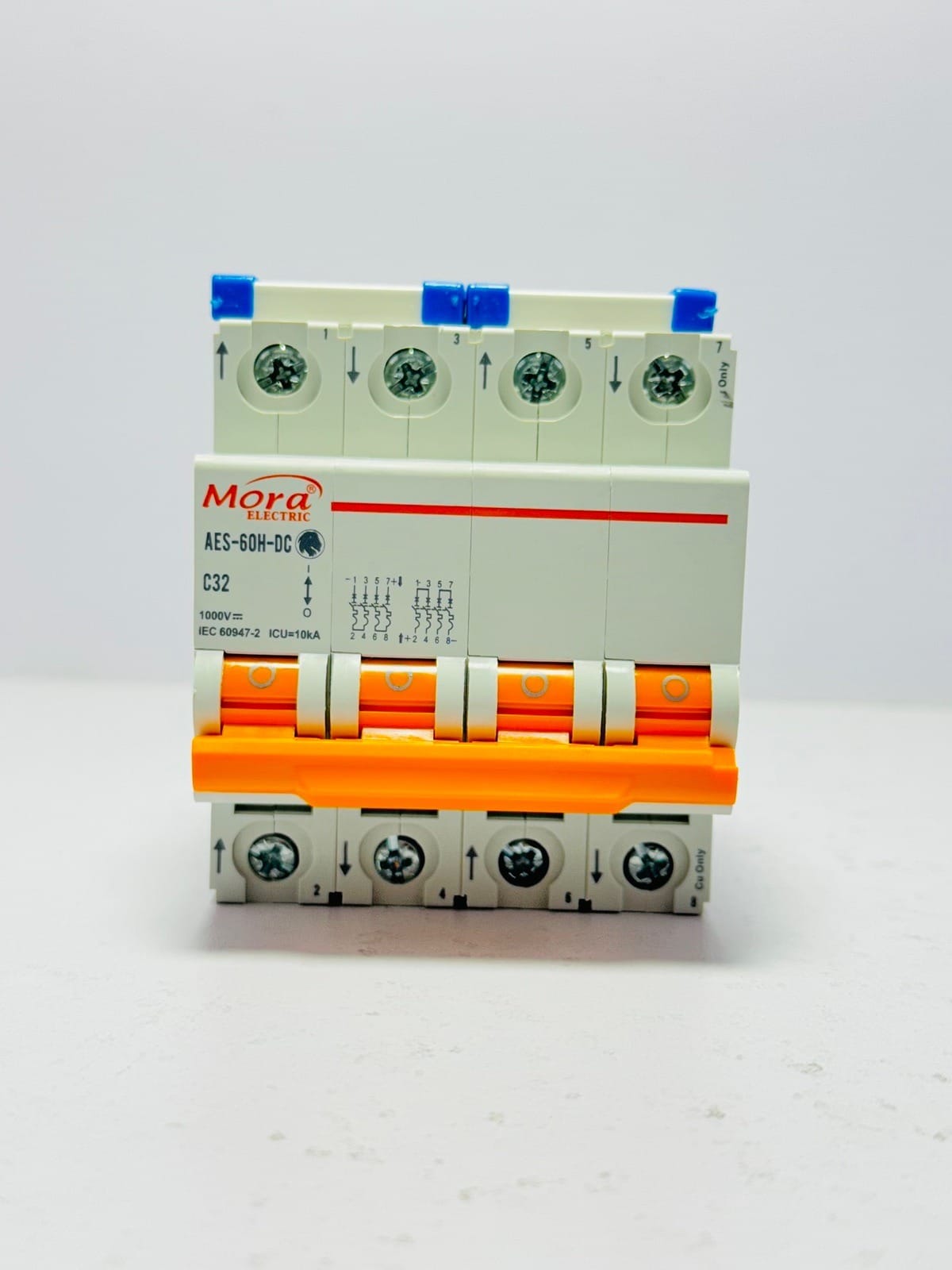
Use a breaker marked for DC at your voltage, with enough DC breaking capacity (kA) for the circuit. Many DC MCBs are polarity-marked (+ and −, or arrows for current direction). Wiring them the wrong way round can stop them clearing a DC arc. Use 2-pole devices so positive and negative switch together.
Worked example: 10kW solar system DC breaker calculation for a Lahore home
A Lahore family wants a 10kW hybrid for load-shedding and a lower WAPDA bill. The installer proposes 18 panels of 585 W (10.53 kWp) and a 10kW hybrid inverter with two MPPTs and a 48 V lithium battery. Panel values (example): Voc 52 V, Isc 14 A, coefficient −0.25 %/°C, max series fuse 25 A or higher.
String layout: 2 strings of 9 panels, one string on each MPPT.
Voltage check (Step 3):
- At 25 °C: 9 × 52 = 468 V
- At 0 °C: 9 × 52 × (1 + 0.0025 × 25) = about 497 V
- At −10 °C: 9 × 52 × (1 + 0.0025 × 35) = about 509 V
So a 500 V breaker is only just enough at 0 °C and too small on a colder morning. That is why we recommend a 1000 V DC MCB even for “only 9 panels”. Also confirm the inverter’s maximum DC input voltage is above 509 V; some single-phase hybrid inverters have lower limits.
Current check (Step 4):
- 14 × 1.25 = 17.5 A, so the next size up is 20 A
- 14 × 1.56 = 21.8 A, so the next size up is 25 A
Both 20 A and 25 A are below the panel’s 25 A+ series fuse limit. Result: two 2-pole 1000 V DC MCBs, 20 A or 25 A, one per string. A 16 A breaker would be too close to the real current and may trip on bright, cool days.
If the installer joins both strings on one MPPT: 28 A × 1.25 = 35 A, so a 40 A DC breaker after the joint. Check that the MPPT accepts 28 A of short-circuit current. With only two strings, extra fuses on each string are usually not needed. That is because one string cannot push more current into the other than the panel can withstand. With three or more strings in parallel, each string needs its own fuse or breaker.

Cold-morning voltage table for Pakistani cities
Pick the lowest sunrise temperature you expect on your roof. These are starting points only; check local weather records for your site.
| Design low | Typical for | 8 panels | 9 panels | 10 panels | 18 panels |
|---|---|---|---|---|---|
| 10 °C | Karachi and coastal Sindh | 432 V | 486 V | 540 V | 971 V |
| 0 °C | Lahore, Faisalabad, Multan, Islamabad cold mornings | 442 V | 497 V | 553 V | 995 V |
| −10 °C | Quetta, upper KP, Gilgit-Baltistan | 452 V | 509 V | 566 V | 1018 V |
Example panel: Voc 52 V, −0.25 %/°C. Values rounded.
Battery breaker for a 10kW hybrid inverter
The battery cable carries the biggest current in the whole system. Size the battery breaker from the inverter’s maximum battery charge/discharge current on its datasheet, not from the battery’s Ah rating.
As a rough check: 10,000 W ÷ 51.2 V ≈ 195 A before inverter losses. That is why a 48 V 10kW hybrid normally needs a DC MCCB in the 200–250 A class, such as the MORA 2P 250A DC MCCB, with battery cable large enough for that current. A lithium battery can deliver a very high short-circuit current, so the breaker’s DC breaking capacity matters more here than anywhere else. High-voltage battery systems carry far less current and need a smaller breaker.
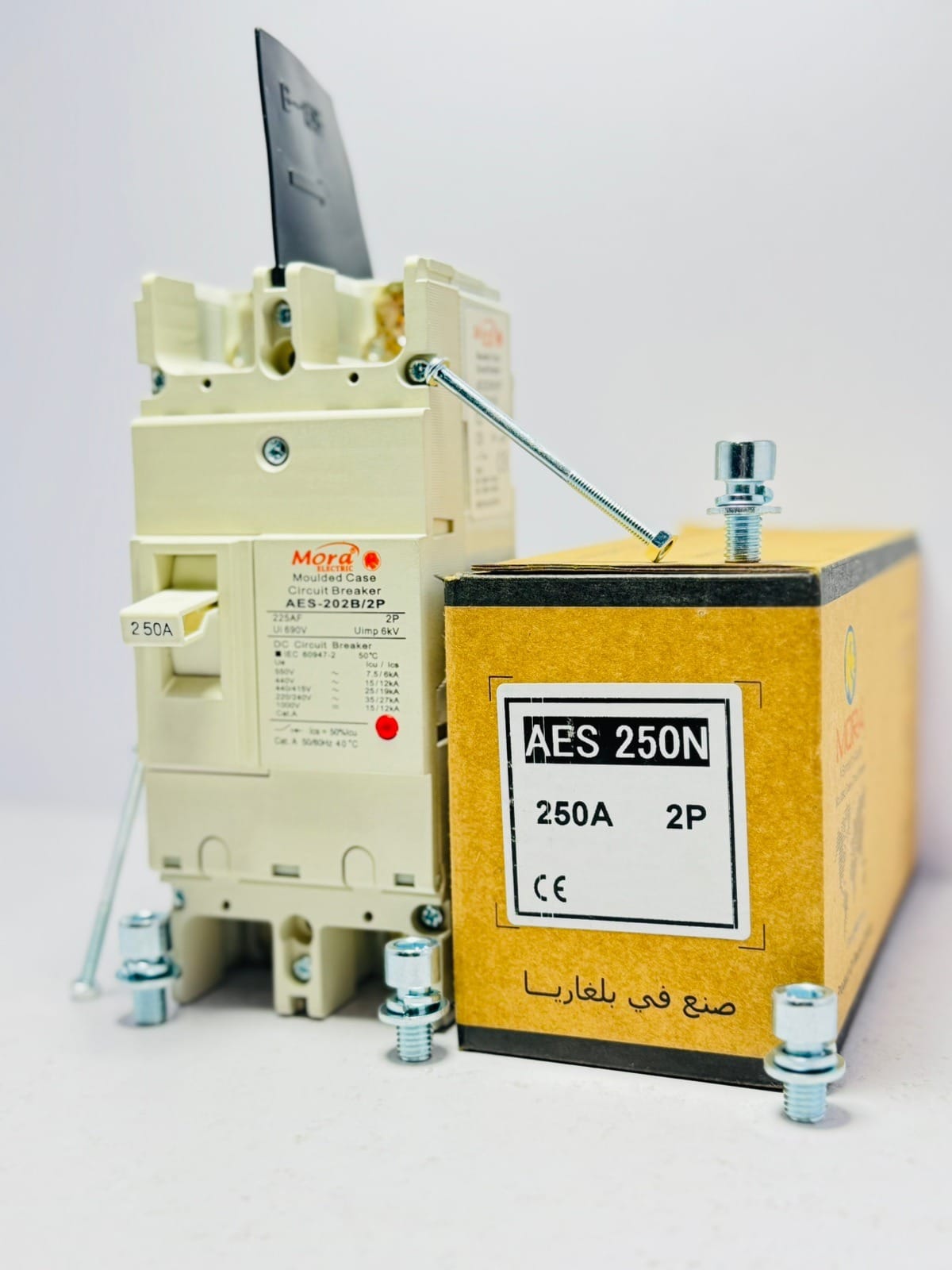
For the difference between small DC MCBs and larger DC MCCBs, see 2-pole DC MCB vs DC MCCB.
AC breaker for a 10kW inverter
On the AC side, current = power ÷ voltage:
- Three-phase 10kW: 10,000 ÷ (1.732 × 400) ≈ 14.4 A per phase. A 4-pole AC MCB, often 20 A or 25 A, is common. Use the size the inverter manual allows.
- Single-phase 10kW: 10,000 ÷ 230 ≈ 43.5 A. A 2-pole 50 A or 63 A MCB as the manual states, with cable sized to match.
Never use an AC MCB on the DC side. AC breakers rely on the current dropping to zero 100 times a second. DC never does that, so an AC breaker may not put out a DC arc.
Pakistan-specific points most guides miss
- Hot DB boxes. In June a DB on a sunny wall can get very hot inside. Thermal breakers trip at lower current when hot, so a breaker sized with no margin may trip at midday. Mount the solar DB in shade, with ventilation.
- Dust and rain. Use an IP65/IP66 enclosure outdoors, such as a Mora IP66 DC isolator near the array, and seal the cable glands.
- Monsoon lightning. Add a Type 2 DC SPD on each MPPT input, wired to a proper earth. See our surge protection devices, and our guide to earthing for solar systems in Pakistan for pit layout and the under-5-ohm target.
- Net metering. On net-metered systems, keep the DC and AC protection neat, labelled and easy to inspect. Your installer will guide you on what your DISCO (LESCO, MEPCO, IESCO and others) asks for.
- Load-shedding hybrids. When the grid drops, the battery breaker carries the full house load, so never undersize it.
Safety notes
Panels make voltage whenever there is daylight: turning off the DC breaker makes the inverter side safe, but the panel side stays live. Work on strings at dawn or dusk or with panels covered, using insulated tools. Switch off the battery breaker before touching battery terminals. If you are not trained, use a qualified electrician.
Checklist before you buy DC breakers for a 10kW system
- ☐ Panel Voc, Isc, temperature coefficient and max series fuse rating noted
- ☐ Number of strings and MPPT inputs confirmed
- ☐ Cold-morning string voltage calculated, below breaker and inverter limits
- ☐ String breaker: 2-pole DC, Isc × 1.25 to 1.56, rounded up, not above the fuse limit
- ☐ Combined breaker sized for parallel strings, if any
- ☐ Battery DC MCCB sized from the inverter’s maximum battery current
- ☐ AC MCB as per the inverter manual
- ☐ DC SPD + earth, IP-rated enclosure, polarity correct
- ☐ No AC MCB on the DC side; no 500 V breaker on 9+ panel strings without a cold check
Genuine 1000 V options in stock: Mora 2P DC 1000V Solar MCB, Tomzn 2P DC 1000V Solar MCB (16 A, 20 A, 32 A and 63 A options) and the MORA 2P DC 40kA SPD. Browse all solar protection products, or read our solar distribution box guide to put it all in one enclosure.
FAQ: DC breaker size for a 10kW solar system
What size DC breaker do I need for a 10kW solar system?
It depends on how the strings are wired. With modern 14 A panels and each string on its own MPPT, use one 2-pole 1000 V DC breaker of 20–25 A per string. If two strings are joined in parallel, the shared breaker needs about 40 A. The battery side of a 48 V hybrid needs a much larger DC MCCB.
Is a 500 V DC breaker enough for a 10kW system?
Often not. A string of 9 panels with 52 V Voc is about 468 V on the datasheet, but it can pass 500 V on a cold morning. With this panel, strings of 10 or more exceed 500 V even at 25 °C. A 1000 V breaker is the safer choice.
How many DC breakers does a 10kW solar system need?
Usually one per string (often two), plus one battery breaker on a hybrid system and one AC breaker on the output. Systems with three or more parallel strings also need protection on each string.
Can I use 16 A DC breakers on a 10kW system?
Only if your panel’s Isc × 1.25 is below 16 A, which suits older panels around 12 A. For today’s 575–600 W panels with about 14 A Isc, 16 A is too close to the real current. Use 20 A or 25 A, within the panel’s maximum series fuse rating.
What size breaker for a 10kW inverter battery?
Take the inverter’s maximum battery current from its datasheet and add margin. On a 48 V system this is often close to 200 A, so a DC MCCB in the 200–250 A class is common. High-voltage battery systems need a much smaller breaker.
Need help sizing breakers for your 10kW system?
Send us your panel datasheet, inverter model and a photo of your planned DB on WhatsApp. Hum aap ke strings, voltage aur battery current check karke sahi DC breaker, MCCB aur SPD bata denge, genuine brands with delivery across Pakistan. WhatsApp HN Electric: 0329 1654950
After you size the DC breaker, pick a matching hybrid from our solar inverters range (including 10 kW models) and, if you need backup, a pack from lithium batteries.
