
Is Stabilizer Required for Inverter AC? Voltage Test, Sizing & Protector Guide (Pakistan)


Is stabilizer required for inverter AC? In most Pakistani homes, no. A modern inverter AC is built to run across a wide voltage window (many models list roughly 150–260 V on the spec sheet), and it switches itself off when the supply leaves that window. You only need a stabilizer if your measured voltage regularly falls below your AC’s own lower limit at peak hours. What every home with an inverter AC should have is a voltage protector on the main line, a dedicated MCB and a proper earth wire. Pehle voltage naapein, phir stabilizer khareedein.
This guide gives you a simple 3-step test to decide for your own house, a sizing method if you do need a stabilizer, and the extra rules for solar, UPS and generator setups that most “stabilizer for inverter AC” articles skip.

Quick answer: when an inverter AC needs a stabilizer
| Your situation | Stabilizer needed? | What to install |
|---|---|---|
| City supply, voltage stays inside the AC’s range even at evening peak | No | Voltage protector on the main line + dedicated AC MCB |
| Voltage dips below the AC’s lower limit for an hour or two on hot evenings | Yes, on the AC circuit | Protector + an inverter-AC rated stabilizer |
| End of a long feeder or rural line, voltage far below range every day | A stabilizer alone is not enough | Fix the supply first (complaint to your DISCO, check service cable), then decide |
| Voltage swings very high late at night or when a neutral is loose | No, a protector is the right tool | Fast over/under-voltage protector; get the neutral checked |
| AC runs on the battery output of a hybrid or UPS inverter | No | Inverter output is already regulated; protect the grid side instead |
How an inverter AC handles low voltage (and where it stops)
An inverter AC does not feed the mains straight into the compressor. The outdoor board first converts AC to DC, then builds its own variable-frequency supply for the compressor motor. Because of that DC stage, the compressor does not “see” small changes in your mains voltage. Many models also have power factor correction, which helps them keep drawing a smooth current when voltage sags.
That is why manufacturers sell inverter ACs as “stabilizer-free”. But this claim has three limits that matter in Pakistan:
- It only covers the printed range. Each model has its own window. One 1.5 ton model may say 150–260 V, another 160–240 V. Check your exact model, not the brand in general.
- Low voltage means more current. To deliver the same power at 170 V instead of 230 V, the AC must draw more amps. Cables heat up more, loose terminals get hotter, and the AC may slow the compressor to protect itself, so cooling drops on the hottest evenings.
- Built-in protection switches off, it does not correct. When voltage leaves the range, the board stops the AC (often with an error code) and restarts after a delay. If that happens many times a night, you need a fix, not just patience.
Stabilizer vs voltage protector vs the AC’s own protection
Shops often sell these as if they were the same thing. They are not. A stabilizer changes the voltage. A voltage protector only disconnects the load when voltage goes outside your set limits and reconnects after a delay. The AC’s built-in protection does the same thing as a protector, but only for the AC itself.
| Device | What it does | Protects | Best for | Watch out for |
|---|---|---|---|---|
| AC’s built-in protection | Stops the AC outside its range | That AC only | Normal city supply | Repeated stop/start on bad nights; no help for the fridge or TV |
| Main-line voltage protector (DIN rail) | Cuts the whole house off on high/low voltage, reconnects after a delay | Every appliance | Every home, especially with loose-neutral or high-voltage risk | Must be rated above your main load or used with a contactor |
| Relay stabilizer | Boosts or bucks voltage in steps | One appliance | Regular evening dips on one AC | Capacity often drops at very low input; check the lowest working input |
| Servo stabilizer | Corrects voltage smoothly with a motor-driven transformer | One large load or whole house | Big loads, slow sustained dips | Slower response; needs maintenance; larger and heavier |
| Surge protection device (SPD) | Diverts very short spikes (lightning, switching) to earth | Everything on the DB | All homes, solar homes especially | Needs a good earth; does not handle long low/high voltage |
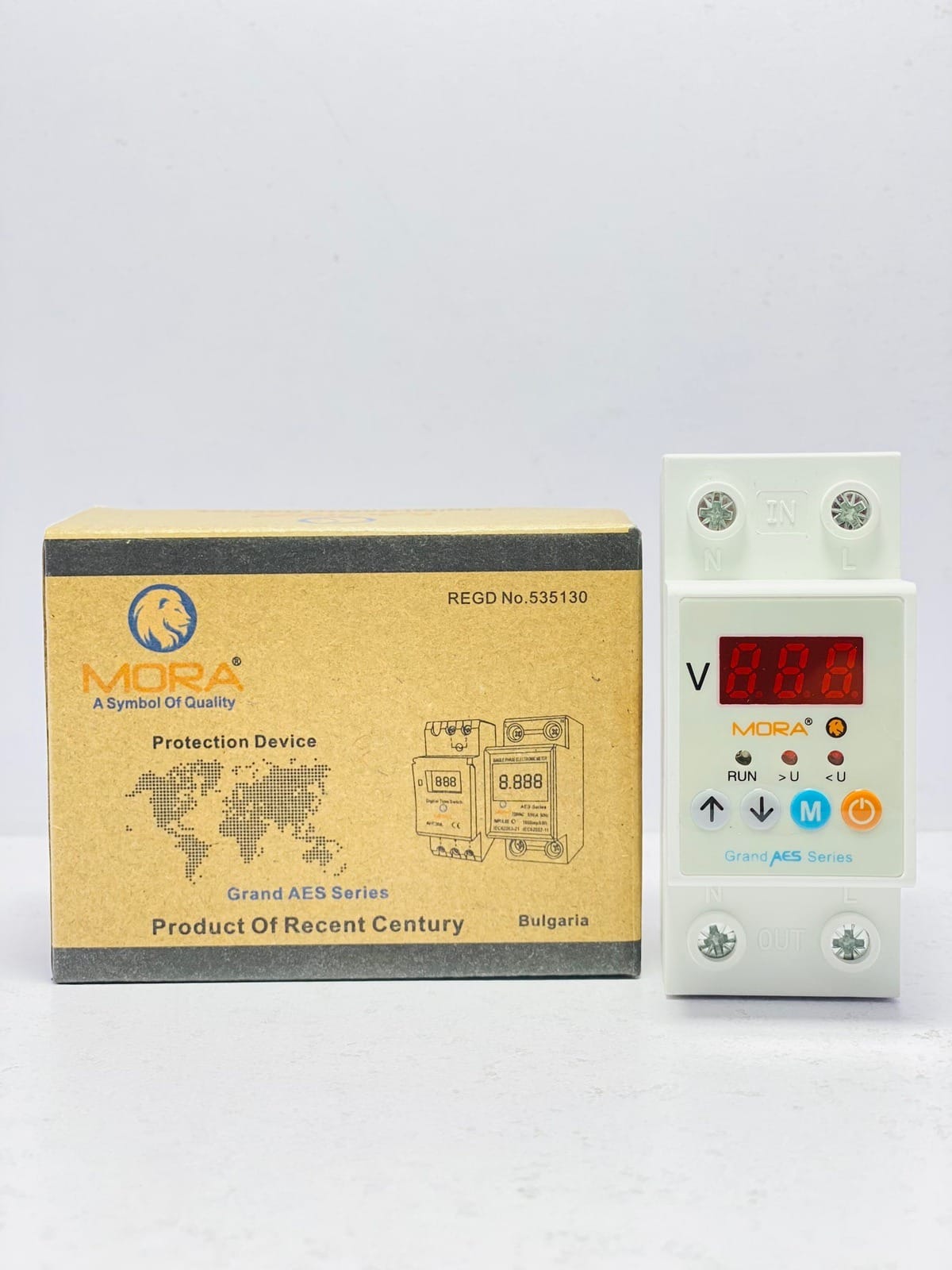
For most homes the right answer is a quality over/under-voltage protector at the main DB. HN Electric stocks DIN-rail units in the surge and voltage protection range, from compact single-phase protectors to three-phase models.
The 3-step test: does your inverter AC need a stabilizer?
Step 1: Find your AC’s working voltage range
Look at the outdoor unit nameplate, the user manual or the official spec sheet for “operating voltage”, “voltage range” or “low voltage startup”. Write down the lowest and highest values. Also note the rated and maximum input current; you will need it for MCB and stabilizer sizing.
Step 2: Measure your voltage at the worst times
Use a multimeter at the AC socket or isolator, or simply read the display of a digital voltage protector. Take readings for three days at these times:
- Hot afternoon, around 3–5 pm
- Evening peak, around 7–11 pm, with your AC and the neighbours’ ACs running
- Late night or early morning, when area load is low and voltage can rise
- Right after power returns from load-shedding
Winter readings are not enough. Many areas look fine in November and fall badly in June. If you can only test in winter, repeat the test in the first hot month.
Step 3: Compare with a safety margin
Keep about 10 V of margin inside the AC’s range. If the AC says 150–260 V, treat 160–250 V as your comfortable zone. Then use the chart above: always inside the zone means protector only; short dips below means protector plus stabilizer; far below every day means the supply must be fixed first.
Worked example: a 1.5 ton inverter AC in a LESCO area
Suppose Bilal in Lahore has a 1.5 ton inverter AC whose spec sheet lists 150–260 V. His comfortable zone is 160–250 V. He logs the protector display for three hot days (these readings are an example, not survey data):
| Time | Day 1 | Day 2 | Day 3 | Inside 160–250 V? |
|---|---|---|---|---|
| 4 pm | 212 V | 208 V | 215 V | Yes |
| 9 pm (peak) | 176 V | 168 V | 181 V | Yes, but close |
| 2 am | 236 V | 241 V | 238 V | Yes |
| After load-shedding | 186 V | 172 V | 190 V | Yes |
Result: no stabilizer. Bilal installs a voltage protector set to cut below about 165 V and above about 255 V, with a restart delay so the compressor does not restart in the middle of a swing. If his 9 pm readings had been 140–150 V on most days, he would add a stabilizer on the AC circuit and also file a low-voltage complaint, because a reading that low is far outside the NEPRA standard.
For reference, the NEPRA Performance Standards (Distribution) Rules set the low-voltage nominal at 400/230 V and require distribution companies to keep at least 95% of consumers within ±5% of nominal, which works out to roughly 218–242 V for a single-phase home. If you regularly read far below that, you have a genuine complaint for LESCO, IESCO, FESCO, MEPCO or your local DISCO.
Voltage stabilizer for 1.5 ton inverter AC: how to size it
If the test says you need one, size it from your AC’s nameplate, not from the shopkeeper’s “1.5 ton ke liye ye wala” advice.
- Find maximum input power. Use the nameplate’s maximum input watts. If only current is given, multiply maximum current by 230 V.
- Convert to VA. With good power factor correction, VA is close to watts. If unsure, divide watts by 0.9.
- Add 25% headroom. Multiply by 1.25 and round up to the next standard size.
- Check low-input capacity. Many stabilizers only deliver full kVA within part of their input range. Read the spec for the lowest input at full load and make sure it is below your worst reading.
- Check inverter-AC suitability. Look for “suitable for inverter AC”, a fast correction speed, a time delay on start, and high/low output cut-offs.
| Nameplate max input (W) | Approx. VA (÷0.9) | × 1.25 headroom | Choose at least |
|---|---|---|---|
| 1,200 | 1,333 | 1,667 | 2 kVA |
| 1,600 | 1,778 | 2,222 | 2.5–3 kVA |
| 2,000 | 2,222 | 2,778 | 3 kVA |
| 2,600 | 2,889 | 3,611 | 4 kVA |
| 3,200 | 3,556 | 4,444 | 5 kVA |
The stabilizer must sit on the AC’s own circuit, after a correctly sized MCB. Our guide on which MCB for 1.5 ton AC covers breaker and wire size from the same nameplate figures.
Inverter AC on solar, UPS or generator
This is where most stabilizer advice goes wrong in Pakistani homes with solar and load-shedding.
- Battery or solar mode: a hybrid or off-grid inverter builds its own regulated 230 V output. A stabilizer after the inverter adds losses and gives nothing back.
- Grid bypass mode: when the inverter is passing WAPDA power through, many models pass the grid voltage as it is. Some hybrid inverters let you choose a wide “appliance” input range or a narrow “UPS” range; the narrow setting makes the inverter switch to battery when grid voltage falls, which protects the AC better. Check your manual for the exact setting.
- Never add a stabilizer between the grid and the inverter input without the installer’s approval. It can confuse the inverter’s grid detection.
- Generator: small generators can sag in voltage and frequency when the AC compressor ramps up. A protector with a restart delay saves the AC from repeated brownouts. Size the generator well above the AC’s input.
If you are planning to run the AC from solar, read can I run a 1.5 ton AC on a solar inverter for inverter, panel and battery sizing.

Where to install a voltage protector for AC
Install the protector after the main MCB and before the DB’s branch breakers, so the fridge, TV, pumps and AC are all covered. If the protector’s rating is lower than your total load, use it to drive a contactor of the right size. Set it like this as a starting point, then adjust to your AC’s range:
- Under-voltage cut: about 10 V above the AC’s lowest working voltage
- Over-voltage cut: about 10 V below the AC’s highest working voltage
- Restart delay: 2–3 minutes or more, to let the compressor pressure settle
Adjustable DIN-rail models such as the Tomzn 4th Gen 2-in-1 over/under voltage protector or the MORA 40A shown above let you set both limits and the delay.

Safety notes
- Switch off the main breaker before any DB work. Voltage protectors and stabilizers carry full load current; terminals must be tight.
- Low voltage plus loose connections is a fire risk. If a socket, plug or MCB terminal is warm or discoloured, fix it before blaming the voltage.
- Do not run an inverter AC through an extension board or a multi-plug. Use a dedicated circuit and a proper earth wire.
- Sudden very high voltage across many appliances often means a broken or loose neutral. Switch off at the main and call an electrician.
- Never bypass the AC’s own protection or a tripping protector to “get the AC running”.
Checklist before you buy a stabilizer for inverter AC
- ☐ AC model’s working voltage range noted from nameplate or manual
- ☐ Voltage measured at afternoon, evening peak, late night and after load-shedding, for 3 days
- ☐ Lowest and highest readings compared with a 10 V margin
- ☐ Main-line voltage protector installed with sensible cut-offs and delay
- ☐ Dedicated AC MCB and wire sized from the nameplate current
- ☐ If a stabilizer is needed: sized from nameplate VA + 25%, inverter-AC rated, low-input capacity checked
- ☐ Solar/UPS homes: inverter input range setting checked; no stabilizer on the inverter output
- ☐ Low-voltage complaint filed with your DISCO if readings are far below standard
FAQs
Is stabilizer required for inverter AC in Pakistan?
Usually not. If your measured voltage stays inside the range printed for your AC model, a voltage protector on the main line is enough. Add a stabilizer only when your readings regularly fall below the AC’s lower limit.
Which stabilizer is best for an inverter AC?
One that states it is suitable for inverter ACs, has a fast correction speed, a start-up time delay, high and low output cut-offs, and enough capacity at your lowest input voltage. Size it from the AC’s nameplate maximum input plus about 25%.
How many kVA stabilizer for a 1.5 ton inverter AC?
It depends on the nameplate. For example, a maximum input of 2,000 W works out to about 2,800 VA with headroom, so a 3 kVA unit. Always check that it can still deliver that capacity at your lowest measured voltage.
Can a voltage protector replace a stabilizer?
It replaces it when voltage stays inside the AC’s range, because then you only need protection from abnormal events. A protector cannot raise low voltage, so in areas with daily deep dips it will keep the AC off; then a stabilizer or a supply fix is needed.
Does an inverter AC need a stabilizer on solar?
Not on battery or solar output, because the inverter output is already regulated. In grid bypass mode, use the inverter’s narrower input range setting if it has one, and keep a voltage protector on the grid side.
Need help choosing a protector for your AC or whole house? Send your AC model and a photo of your DB to HN Electric on WhatsApp: 0329 1654950. We will suggest the right protector, MCB and wiring for your load.
